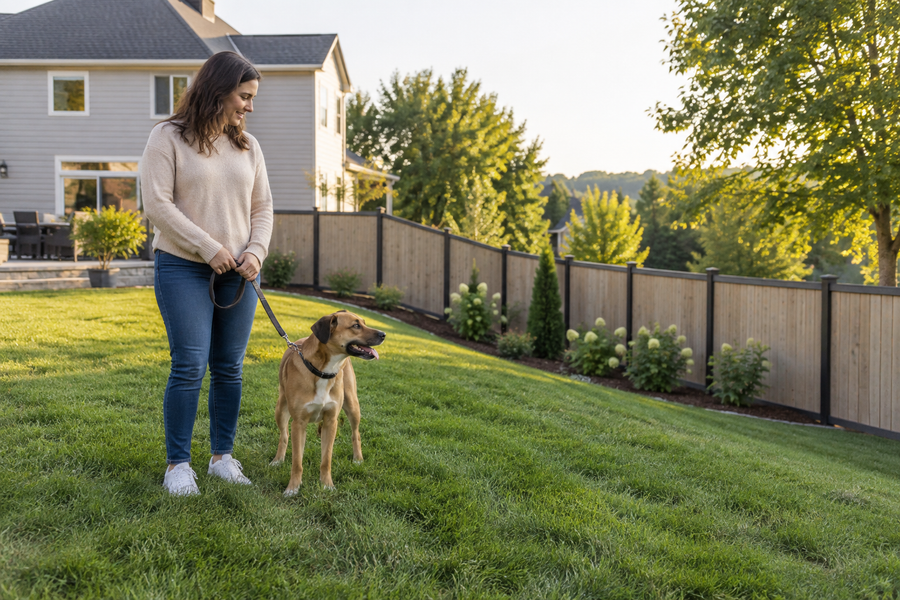
A wireless dog fence creates an electronic boundary instead of a visible wall. Depending on the system, an indoor transmitter may broadcast a circular radio zone, or a GPS-enabled collar may compare the dog’s location with a virtual boundary saved in an app. When the collar detects that the dog is approaching or crossing the boundary, it provides the configured warning or feedback.
The important limitation is that a wireless fence does not physically stop a dog. It works as a boundary-awareness and training system, so safe placement, reliable equipment, humane training, supervision, and backup identification all remain essential.
Quick Answer: How Does a Wireless Dog Fence Work?
Most wireless dog fence systems follow the same basic process:
- The owner defines a safe area. A transmitter creates a circular zone, or an app stores a GPS boundary.
- The receiver collar monitors the boundary. It measures a radio signal or calculates its GPS position.
- The collar detects when the dog approaches the edge. The exact warning distance depends on the product and its settings.
- The collar provides a configured cue. This may be a tone, vibration, or another feedback option supported by the system.
- Training teaches the dog what the cue means. The dog learns to turn back toward the safe area.
- Connected GPS systems may alert the owner. Cellular service can deliver escape notifications and location updates to a phone.
That is the short answer. The details depend on which type of “wireless” fence you are considering.
What Is a Wireless Dog Fence?
The term wireless dog fence is used loosely. In its narrowest sense, it describes a transmitter-based system that creates a circular radio boundary without a buried wire. Shoppers and manufacturers also use the term for GPS dog fences, which create map-based virtual boundaries without a base station or perimeter wire.
An underground or in-ground fence is often included in the same electronic-fence category, but it is not truly wireless because it requires a buried boundary wire.
Unlike a physical fence, none of these electronic systems blocks traffic, wildlife, other dogs, or people from entering the property. They are designed to help a trained dog recognize a boundary—not to build a physical barrier.
The Three Main Types of Electronic Dog Fences
| System | How the boundary is created | Typical boundary shape | Best suited to | Main limitation |
|---|---|---|---|---|
| Base-station wireless fence | An indoor transmitter broadcasts a radio signal | Usually circular | Smaller or standard yards where a circle fits | Limited shape flexibility and possible interference from structures or metal |
| GPS wireless dog fence | Satellite positioning compares the collar’s coordinates with a saved digital boundary | Circular or custom, depending on the product | Larger yards, farms, ranches, and irregular properties | GPS performance varies by environment; connected features may require cellular service |
| In-ground dog fence | A transmitter sends a signal through a buried perimeter wire | Custom shape following the wire | Fixed properties needing a defined perimeter | Requires installation and is not truly wire-free |
The best choice depends less on the marketing name and more on your property size, boundary shape, nearby hazards, signal conditions, dog, and willingness to complete training.
1. Base-Station Wireless Dog Fences
A traditional wireless fence uses a transmitter placed inside the home, garage, or another protected location. The transmitter sends a radio signal outward, creating a circular safe zone around the base.
The dog wears a receiver collar that monitors the signal. As the collar reaches the programmed edge of the coverage area, it provides the system’s warning cue. Because the transmitter is the center of the circle, the boundary normally cannot trace an L-shaped yard, follow a property line, or exclude a pond on one side.
Current manufacturer documentation for transmitter-based systems describes the same general arrangement: an indoor transmitter broadcasts a circular radio boundary, while the receiver collar responds near the signal’s edge. Coverage, response sequence, and supported feedback vary by model.

2. GPS Wireless Dog Fences
A GPS dog fence replaces the indoor transmitter and buried wire with satellite positioning and a digital map.
The owner creates a boundary in an app or on the collar. The collar receives signals from GPS or other Global Navigation Satellite Systems (GNSS), calculates its position, and compares that position with the active virtual fence. When the dog approaches or crosses the saved line, the collar follows the product’s configured response.
GPS systems can be useful when an owner needs:
- A custom-shaped boundary
- Multiple fences at different locations
- Coverage across a larger property
- No-go zones inside a main boundary
- Live location tracking and escape alerts
GPS determines the collar’s location; cellular service sends information to a remote phone. Those are separate functions. Some GPS fences can enforce a locally stored boundary without cellular service, while others require a subscription for fence functions, live tracking, alerts, or app syncing. Always verify the requirements for the exact device.
For a deeper technical explanation, read how a GPS dog fence works.

3. In-Ground Dog Fences
An in-ground system uses a transmitter connected to a wire buried around the property. The wire forms a closed loop and carries the boundary signal. When the receiver collar approaches the wire, it provides the configured warning or feedback.
The advantage is shape control: the wire can follow a property edge or curve around a garden. The tradeoff is installation. The system requires trenching, a continuous loop, and repairs if the wire breaks.
Although people may call this an “invisible fence,” it should not be confused with a truly wireless or GPS-based system.
How a Wireless Dog Fence Works Step by Step
Step 1: You Define the Safe Area
With a base-station fence, you place the transmitter and adjust the radius. With a GPS fence, you draw or walk the boundary in an app. With an in-ground system, the installed wire defines the perimeter.
The boundary should sit well inside roads, pools, cliffs, driveways, farm equipment areas, and other immediate hazards. An electronic boundary needs room for signal variation and for the dog to notice the cue, turn, and return safely.
Step 2: The Collar Determines Its Relationship to the Boundary
A transmitter-based receiver monitors the radio signal created by the base. A GPS collar calculates its coordinates from satellite signals. An in-ground receiver detects the signal carried through the perimeter wire.
The collar then decides whether it is comfortably inside the safe area, approaching the warning zone, or beyond the saved boundary.
Step 3: The Collar Provides the Configured Cue
The cue depends on the product. It may include:
- An audible tone
- Vibration
- A voice or recall cue
- Optional static feedback where supported and legally available
There is no universal response pattern. Warning distance, timing, intensity, safety shutoffs, and re-entry behavior vary, so the owner must follow the current manual for the specific model.
Step 4: Connected Systems Communicate With the Owner
A connected GPS fence may send a boundary-crossing alert to the owner’s phone. The app may also show a current or recent location and movement history.
These remote features depend on the collar’s battery, network coverage, account status, and telecom plan. A delayed phone notification does not necessarily mean the GPS receiver failed; the collar may have calculated a location before the cellular network delivered it to the app.
Step 5: Training Gives the Boundary Meaning
A dog cannot see a radio circle or a line drawn on a map. At first, the collar’s tone is simply a sound. Training connects the visible location, the warning cue, and the behavior of returning to the safe area.
Without that learning process, a dog may ignore the cue, become confused, or run through the boundary when highly distracted.
What Happens If a Dog Crosses the Wireless Fence?
The answer depends on the system and its settings. A typical sequence may be:
- The dog enters the warning area.
- The collar provides a tone, vibration, or another configured cue.
- The dog continues across the boundary.
- The collar changes or repeats its response according to the product settings.
- A connected system sends an escape alert when network communication is available.
- The owner begins recall, supervision, or live tracking.
A wireless fence cannot guarantee that a dog will stop. Fear, prey drive, another animal, a loud noise, or a fast-moving distraction may cause a dog to cross despite training. Some dogs may also hesitate to return if the product’s re-entry behavior is not understood. Test that behavior before relying on the system.
Does a Wireless Dog Fence Need Wi-Fi, Cellular Service, or a Subscription?
Not every wireless fence has the same connectivity requirements.
| System | GPS required? | Wi-Fi required for the boundary? | Cellular service or subscription? |
|---|---|---|---|
| Base-station wireless fence | No | Usually no | Usually no |
| GPS wireless fence | Yes | Usually not for outdoor positioning | Model-dependent; often required for remote alerts, app syncing, or live tracking |
| In-ground fence | No | No | Usually no |
Wi-Fi, GPS, and cellular service do different jobs:
- GPS/GNSS calculates outdoor position.
- Cellular service transfers location data and alerts between the collar and phone.
- Wi-Fi or Bluetooth may help with setup, updates, or short-range syncing, depending on the product.
Do not assume that a product works without a subscription just because it uses GPS. Check which functions remain available without an active plan.
How Accurate Is a Wireless Dog Fence?
Accuracy depends on the type of fence.
For a base-station system, transmitter placement, metal objects, terrain, walls, and signal interference can affect the boundary. For a GPS fence, satellite visibility, tree cover, buildings, reflected signals, terrain, receiver design, and update timing all matter. In-ground systems are tied to the wire location but can fail if the wire, transmitter, power source, or receiver develops a problem.
The U.S. government’s GPS accuracy guidance explains that its performance commitments apply to the signal transmitted in space—not to the accuracy of a particular consumer device. Real-world performance also depends on the receiver and local conditions.
Before off-leash use:
- Walk the complete boundary with the collar in your hand.
- Mark the warning area with visible flags.
- Repeat the test near buildings, trees, slopes, and other difficult areas.
- Leave a generous buffer before roads, water, property edges, or equipment.
- Test again on different days and after software or boundary changes.
- Introduce the dog only on leash and under direct supervision.
For more detail, see how accurate GPS dog collars and virtual boundaries are in real life. If your system is generating inconsistent notifications, use this virtual fence false-alert checklist.
Does a Dog Need Training for a Wireless Fence?
Yes. A wireless fence is not an instant containment system. The dog must learn where the boundary is and what the warning cue means.
A safety-first introduction can include:
- Mark the boundary visually. Use temporary flags so the invisible line has a physical reference.
- Begin on leash. Walk toward the boundary slowly without forcing the dog into it.
- Use the least intrusive cue available. Begin with a tone-only setting when the product supports it.
- Reward the turn back. Mark and reward movement toward the safe area with treats, praise, or play.
- Keep sessions short. Stop before the dog becomes tired, worried, or frustrated.
- Add distractions gradually. Do not begin with wildlife, visitors, vehicles, or another high-value trigger.
- Supervise all early practice. Progress should depend on calm, repeatable behavior—not a promised number of days.
The American Veterinary Society of Animal Behavior recommends reward-based training and advises against aversive methods, including electronic shock collars. If a dog freezes, panics, vocalizes, redirects aggression, or repeatedly runs through the boundary, stop and consult a qualified reward-based trainer or veterinary behavior professional.

Where Does Each Type of Fence Work Best?
Choose a Base-Station Wireless Fence When:
- A circular boundary fits comfortably inside the yard
- The property is relatively small, open, and level
- You want fast setup without digging
- An indoor transmitter can be placed in an appropriate location
- You do not need live GPS tracking or a custom perimeter
Choose a GPS Wireless Dog Fence When:
- The property is larger or irregularly shaped
- You need multiple portable boundaries
- You want no-go zones or map-based customization
- Open-sky conditions are available across most of the property
- You want escape alerts or live location features
- You can maintain charging and any required telecom plan
Choose an In-Ground Fence When:
- You need a fixed boundary that closely follows the property
- The yard is too narrow or complex for a transmitter circle
- You are willing to install and maintain a buried wire
- GPS conditions are poor but an electronic boundary is still appropriate
When Is a Physical Fence the Safer Choice?
A physical fence may be a better primary barrier when:
- The yard borders a busy road, railroad, cliff, pool, or other immediate hazard
- There is not enough room for a safety buffer
- The dog is highly fearful, reactive, or likely to bolt through a cue
- Satellite or transmitter performance is inconsistent on the property
- You need to keep wildlife, roaming dogs, livestock, or people out
- The dog cannot comfortably wear the required collar
- The owner cannot complete training and ongoing testing
Even when a wireless fence is appropriate, maintain additional safety layers such as direct supervision, recall training, an identification tag, a registered microchip, and secure physical containment when conditions require it.
How SATELLAI’s GPS Wireless Dog Fence Works
The SATELLAI Collar is a GPS-based wireless dog fence rather than a circular base-station system. Owners create virtual fences in the SATELLAI app, and the collar uses dual-frequency, dual-antenna positioning across five GNSS constellations to determine its location relative to the saved boundary.
Current SATELLAI specifications include:
- Unlimited custom-shaped virtual fences
- Individual fence sizes from 0.5 to 100,000 acres
- Custom no-go zones inside a fence
- Configurable boundary feedback and escape alerts
- Live GPS tracking and location history
- IP68 water and dust resistance
- Up to three days of maximum battery life
SATELLAI is designed primarily for larger yards, farms, ranches, and repeatable outdoor routines. An active Telecom Plan is required for its fence, real-time tracking, escape alerts, and other connected app features. SATELLAI also recommends placing a virtual boundary at least about 50 feet from the house to reduce indoor false alerts; a Home Beacon may be appropriate when the home sits closer to the line.
Feedback features and availability may vary by country or region. The system does not create a physical barrier and should not replace responsible training, supervision, or appropriate physical fencing. Review the complete GPS wireless dog fence compatibility and safety information before deciding whether it fits your property and dog.
Frequently Asked Questions
Do Wireless Dog Fences Really Work?
They can support boundary awareness for an appropriately trained dog when the system fits the property, the collar is charged and fitted correctly, and the full perimeter has been tested. They cannot physically prevent every escape or replace supervision.
Does a Wireless Dog Fence Need Wi-Fi?
Most base-station and in-ground systems do not need Wi-Fi for the boundary. GPS fences use satellite signals for positioning, although Wi-Fi or Bluetooth may support setup or syncing. Product requirements vary.
Can a Wireless Dog Fence Work Without a Subscription?
Some can. Base-station and in-ground systems commonly operate without subscriptions. GPS models vary: some charge only for remote tracking, while others require a plan for fence and app functions. SATELLAI requires an active Telecom Plan for its essential connected features.
Can a Dog Run Through a Wireless Fence?
Yes. A highly motivated, frightened, or fast-moving dog may cross the boundary. A wireless fence provides a cue, not a physical barrier, which is why training, buffer distance, and supervision matter.
Will a Wireless Dog Fence Work Under Trees?
A radio transmitter may work under trees, although structures, terrain, and interference can affect coverage. GPS fences may become less consistent under dense canopy because leaves and branches can weaken satellite reception. Test the actual property before use.
Is a Wireless Dog Fence the Same as an Invisible Fence?
Not necessarily. “Invisible fence” is often used for any nonphysical electronic boundary, including buried-wire, transmitter-based, and GPS systems. The underlying technology and installation requirements are different.
Can a Wireless Dog Fence Replace a Physical Fence?
Not in every environment. It cannot block traffic, stop other animals from entering, or guarantee that a dog will remain inside. Properties beside immediate hazards may require secure physical containment.
How Long Does Wireless Fence Training Take?
There is no reliable universal timeline. Training speed depends on the dog, system, property, distractions, previous experience, and consistency. Move forward based on calm, repeatable understanding rather than a predetermined number of days.
Final Takeaway
A wireless dog fence works by defining an electronic boundary and using a receiver collar to recognize when a dog approaches or crosses it. A base station creates a circular radio zone, a GPS fence compares satellite coordinates with a digital map, and an in-ground system follows a buried signal wire.
The technology identifies the boundary; training gives it meaning. The right system must fit the property, provide enough room for a safety buffer, work reliably in local conditions, and be used as one part of a broader dog-safety plan.
Editorial and Accuracy Note
This guide was reviewed on August 24, 2026, using current SATELLAI product information, GPS.gov positioning guidance, AVSAB’s humane dog-training position, and current manufacturer documentation for transmitter-based wireless fences. Product features, subscriptions, coverage, feedback availability, and local regulations can change. Verify the current product manual and applicable rules before use.