Quick answer: Positive reinforcement means adding something your dog values immediately after a behavior you want to see again. It can be food, play, praise, access to sniffing, or another real-life reward. Clear timing and easy practice are more important than perfect commands.
Training is communication. When your dog understands what earns good outcomes, they are more likely to repeat that behavior. Reward-based training focuses on teaching the skills you want—such as coming when called, walking on a loose leash, settling on a mat, or waiting at a door—rather than relying on fear, pain, or intimidation.
The American Veterinary Society of Animal Behavior recommends reward-based methods for dog training and behavior modification. For most families, the practical takeaway is straightforward: set your dog up to succeed, reward the right moment, and make the next step manageable.
How positive reinforcement works
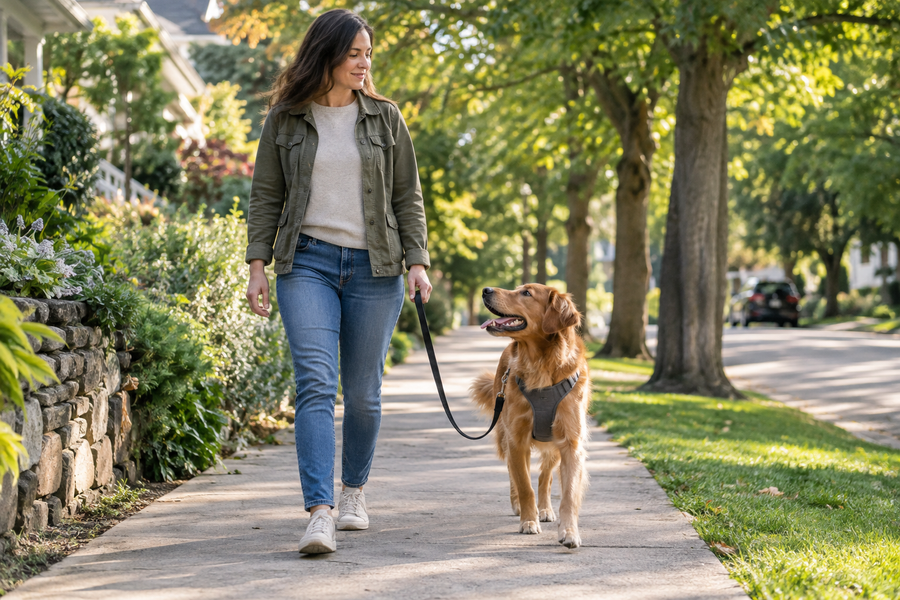
If your dog sits and a treat arrives, sitting is more likely to happen again. If they walk beside you on a loose leash and get to continue toward an interesting smell, staying near you becomes worthwhile. The reward is defined by your dog’s behavior: if a consequence makes that behavior more likely in the future, it is reinforcing.
Food is often convenient, especially when learning a new skill, but it is not the only reward. Many dogs work for toys, a game of tug, praise, a chance to greet a friend, access to the yard, or permission to sniff.
The AVSAB glossary of training terms explains markers, luring, capturing, and shaping. You can combine these methods while keeping the task easy enough for your dog to understand.
Choose rewards your dog actually values
Start with a few small, easy-to-eat treats. In a low-distraction living room, ordinary food may be enough. In a busy park, you may need something more exciting. Keep treats tiny so a training session does not become a large meal.
Observe what your dog chooses. A dog who turns away from a treat may be full, worried, distracted, or simply not interested in that option. Instead of assuming they are stubborn, lower the difficulty or try a different reward.
Timing is everything
Reward the behavior at the moment it happens. If you want four paws on the floor when visitors arrive, deliver the treat while all four paws are down—not after the dog has jumped, landed, and walked away.
A short marker word such as “yes” can bridge the gap between the behavior and the reward. Say “yes” exactly when your dog does the right thing, then give the treat. A clicker can work in the same way if you first teach your dog that the click predicts a reward. Follow every marker with the promised reward, even if you marked at the wrong moment; then adjust your timing on the next repetition.
Teach one small step at a time
Break skills into pieces your dog can understand. For a “settle on a mat” behavior, begin by rewarding one glance at the mat. Then reward a step onto it, then four paws, then a sit or down, and finally a few seconds of calm rest.

This gradual process is often called shaping. It avoids waiting for the entire finished behavior to happen by chance and gives your dog lots of opportunities to succeed.
Lure, then fade the lure
A food lure can help introduce a movement. For example, you can guide a treat from your dog’s nose slightly upward and back to encourage a sit. Once the motion is familiar, make the hand movement smaller, then use the same gesture without food in your hand. Reward from the other hand after the behavior.
Add the verbal cue only when you can predict the behavior. Say “sit” once, then let your dog perform the action. Repeating a cue before the dog understands it can turn the word into background noise.
Manage the environment while you train
Training does not happen only during formal sessions. If your dog practices pulling all the way to every interesting smell, pulling is being rewarded by the environment. If they rehearse jumping on visitors, jumping becomes stronger.
Use thoughtful management so unwanted behaviors are less likely to pay off while you teach alternatives. A baby gate, leash, quiet room, chew item, or more distance from a trigger can prevent practice of a difficult behavior. Management is not cheating; it gives learning a chance to work.
Keep sessions short and clear
Aim for one to five minutes, especially with puppies or a new skill. End on an easy success. Several short sessions spread through the day usually beat one long session where everyone becomes frustrated.
Work first in the easiest environment, then gradually add distance, duration, and distraction. Change just one of these at a time. If your dog struggles, make the next repetition easier rather than pushing through.
If your dog repeatedly turns away or becomes tense, check the signs of stress in dogs before changing rewards or asking for more repetitions.
What to do when your dog makes a mistake
Mistakes are feedback, not defiance. If your dog does not respond, ask whether the cue is clear, the reward is valuable, or the setting is too hard. Help them succeed with a simpler version and reward that.
Avoid yelling, leash jerks, shock, choke, or prong collars. Punishment may stop a behavior in the moment but can add fear, confusion, or risk to the relationship. For biting, reactivity, guarding, separation distress, or other serious concerns, seek help from your veterinarian and a qualified reward-based professional.
A two-minute training session you can repeat
Choose one small goal, such as placing front paws on a mat. Put the mat nearby, have rewards ready, and keep the room quiet.
- Watch for a glance or movement toward the mat.
- Mark that moment and deliver one small reward.
- Reset by allowing your dog to move away.
- Repeat the same easy step a few times.
- Ask for a little more only if the dog is confidently repeating the step.
- Finish with a break while your dog is still comfortable.
Write down what worked. “Three voluntary steps onto the mat” gives you a clearer starting point tomorrow than “good session.”
Troubleshooting reward-based training
| What is happening | What to change first |
|---|---|
| Your dog responds only when food is visible | Fade the lure; give the cue before reaching for the reward |
| Your dog walks away mid-session | Shorten the session and check comfort, fatigue, and distractions |
| The skill works indoors but not outside | Practice an easier version in a quieter outdoor location |
| Everyone uses a different cue | Agree on one cue and one observable behavior |
| Jumping or barking happens between repetitions | Reward earlier and reduce waiting; check whether the task is frustrating |
For the outdoor issue, use SATELLAI's guide to rebuilding focus around distractions. When you need to help a dog relax between sessions, arrange a comfortable resting space.
Everyday ways to use positive reinforcement
- Reward your dog for checking in with you on walks.
- Give a treat when they lie quietly while you make dinner.
- Open the door after a calm pause instead of when they are jumping.
- Reinforce a recall with something special, even after it is well learned.
- Reward a puppy for choosing a chew toy instead of household items.
Small, timely rewards shape daily habits more effectively than waiting for a problem to become frustrating.

How to choose a reward-based trainer
Ask what the trainer will do if your dog does not respond, how they handle fear, and whether you may observe a session. Look for specific explanations, realistic goals, and willingness to refer medical concerns to a veterinarian. Avoid promises of a guaranteed result within a fixed number of sessions.
Use AVSAB's current public guidance when evaluating methods; a professional title alone does not tell you how someone trains.
Frequently asked questions
Will my dog only listen if I have treats?
Treats are a useful teaching tool, not a permanent bribe. Once your dog understands a skill, vary the rewards and use real-life rewards such as play, sniffing, or going outside. Continue rewarding important behaviors often enough to keep them strong.
What if my dog is not food motivated?
Try toys, play, praise, access to a favorite activity, or a different type of food. Also consider whether your dog is stressed, full, tired, or training in a setting that is too distracting.
Is positive reinforcement the same as permissive training?
No. Reward-based training still includes clear boundaries and thoughtful management. It teaches your dog what to do and prevents unsafe behavior without using fear or pain.
Editorial note
This article is general education. A trainer should be transparent about methods, teach without fear or force, and work alongside your veterinarian when behavior may involve pain, anxiety, or safety risk.