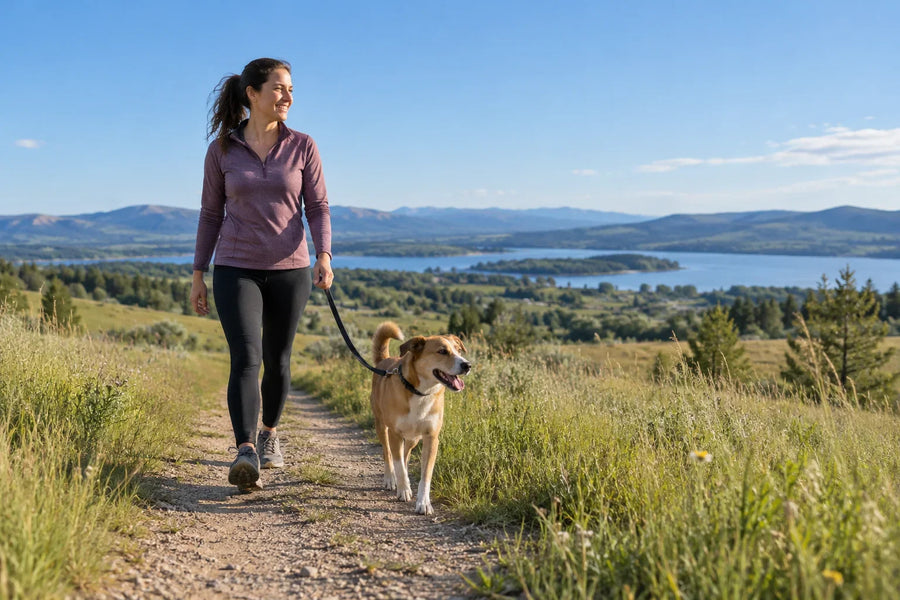
A GPS dog collar can look impressive on a product page, but the more important question is how it performs when a real dog approaches the edge of a real property.
That is what the creator behind Rockhill Farm explored while testing the SATELLAI Collar with two young dogs: Nebula, a timid Shar-Pei, and Rocket, a more energetic dog with a tendency to run off. Their home is surrounded by dense woods, making an escape particularly concerning.
The reviewer disclosed that SATELLAI supplied the products used in the video, but said he was not paid to provide a particular opinion. After approximately one week of use, he demonstrated the app, virtual fences, individual feedback settings, activity monitoring and an outdoor boundary test.
This review separates three types of information:
- What was directly shown in the video
- What the reviewer personally observed
- What owners should understand before relying on a virtual fence
It does not treat one short test as proof that the product will perform identically for every dog, property or environment.
SATELLAI Collar Review: The Quick Verdict
The SATELLAI Collar appeared to address this family’s central problem: giving two dogs more room to exercise without installing an expensive physical fence across the front yard.
During the test, the reviewer was able to:
- Draw and modify a virtual boundary in the SATELLAI app
- Save multiple virtual-fence areas
- View Nebula and Rocket separately on the map
- Configure different boundary feedback for each dog
- Review walking, running and resting activity
- Use a Beacon to establish localized no-go areas
- Receive notifications if a dog crossed a boundary
The most relevant moment occurred when Rocket approached the configured boundary, reacted to a collar cue and immediately turned back. However, only one clear boundary response was shown, and the reviewer could not identify whether Rocket had heard a tone, felt a vibration or received another configured cue.
Quick answer: The SATELLAI Collar showed useful virtual-fence and tracking capabilities in this rural-property test, but it should be treated as a GPS tracking and boundary-training system—not a physical barrier or guaranteed containment solution.
Why This Family Needed a GPS Dog Collar
The product test began with an ongoing disagreement between the reviewer and his wife. She wanted a fenced area where Nebula and Rocket could run and play. He was reluctant to fence the front yard for several practical reasons:
- A fence would change the appearance of the property.
- It would create additional trimming and maintenance.
- It could obstruct tractors, side-by-sides and other equipment.
- Materials and installation would be expensive.
- Fencing the side yard would first require drainage and lighting work.
The property also presented a meaningful escape risk. Beyond the yard were large areas of brush and untouched woodland. Rocket was described as energetic and likely to take off, while the reviewer acknowledged that he could not physically outrun either dog.
This is the type of scenario in which a GPS dog tracker can provide an additional layer of visibility. The family did not want activity data alone; they wanted a system that could establish a consistent outdoor boundary and help locate a dog if that boundary was crossed.
Owners comparing this type of system with traditional fencing can learn more from SATELLAI’s wireless dog fence guide.
How the SATELLAI Collar Was Tested
The reviewer had used the collars for approximately one week before filming. The review included two main components:
- A screen recording showing the app, dog profiles and virtual-fence settings
- An outdoor session observing how the dogs behaved near the boundary
This was a practical household trial rather than a controlled technical study. The video did not:
- Measure GPS accuracy in feet
- Compare the SATELLAI Collar with another GPS device
- Test performance over several months
- Document results across different weather conditions
- Simulate a complete long-distance escape and recovery
- Test a high-distraction event involving wildlife, traffic or another dog
The video therefore provides credible first-hand evidence about setup and initial use, but it does not establish universal performance.
Creating a Virtual Dog Fence in the SATELLAI App
The reviewer demonstrated a blue boundary drawn around part of his property. From the fence menu, he selected the editing tool and repositioned points on the map to change where the dogs were allowed to roam.
One example involved deciding how close the dogs should be permitted to approach a pond. He adjusted the boundary, saved it and assigned it a name. The app also allowed him to create multiple zones, such as one boundary for the property and another for a park.
This flexibility is one of the clearest differences between a GPS virtual fence and a physical or buried-wire fence. A digital boundary can be modified without installing posts, digging trenches or relocating hardware.
According to SATELLAI’s explanation of how its GPS dog collar works, owners can create multiple custom-shaped virtual fences, establish safe and restricted zones and select optional boundary feedback.
Why a Safety Buffer Still Matters
A GPS boundary should not be placed directly against a road, pond, cliff or other immediate hazard.
Satellite positioning can vary because of tree cover, buildings, terrain, weather and other obstructions. SATELLAI states that positioning may typically fall within three to five feet in open areas, but accuracy can change in dense forests and other obstructed environments.
For that reason, owners should:
- Leave a generous buffer between the digital boundary and a hazard
- Test the boundary while the dog is secured with a leash or long line
- Confirm how the collar behaves in different parts of the property
- Avoid treating the boundary shown on the map as an exact physical line
In the video, the reviewer placed the virtual fence near the pond. A more conservative implementation would move that boundary farther away to account for normal GPS variation.
Individual Boundary Settings for Each Dog
The app allowed the reviewer to configure feedback separately for Rocket and Nebula.
For Rocket, the video showed progressively different settings across three boundary stages:
| Boundary stage | Tone setting | Vibration setting | Static setting |
|---|---|---|---|
| Near the boundary | 7 | 1 | Disabled |
| At the boundary | 11 | 2 | 5 |
| Crossing the boundary | 15 | 3 | 10 |
These were the reviewer’s personal settings during the demonstration. They should not be interpreted as recommended settings for every dog.
Nebula had a separate configuration because she was more timid than Rocket. This per-dog customization is useful in a multi-dog household, where temperament, training history and sensitivity may differ substantially.
An Important Training and Welfare Consideration
The video discusses tone, vibration and optional static feedback. It also shows the reviewer testing the static stimulus on himself. That personal test does not establish how an individual dog will perceive or respond to the same stimulus.
The American Veterinary Society of Animal Behavior states that reward-based methods should be used for dog training and advises against aversive methods, including electronic collars. Owners should review the AVSAB Humane Dog Training Position Statement and consult a qualified trainer or veterinary behavior professional when appropriate.
A responsible boundary-training plan should prioritize:
- Visible boundary markers
- Leash or long-line introductions
- Recall practice
- Immediate rewards for returning
- Consistent, supervised sessions
- Tone or other non-static cues where suitable
The collar should support an established training process rather than replace one.
What Happened During the Outdoor Boundary Test?
The most significant real-world moment occurred when Rocket moved toward the edge of the configured area.
In the footage, Rocket suddenly reacted and turned back toward the permitted area. The reviewer believed the collar had activated a whistle, vibration or another configured stimulus, although he did not confirm which mode triggered.
He interpreted the response as evidence that Rocket was beginning to associate the boundary with the collar’s cues.
That observation is useful, but its limitations should remain clear:
- Only one obvious response was shown.
- The exact feedback mode was not identified.
- The collar had been used for only about one week.
- Rocket was being observed during the test.
- No high-distraction escape attempt was documented.
- The video did not show whether the response remained consistent over time.
The result indicates that Rocket noticed something near the boundary and returned. It does not prove that the collar will stop every dog or every escape attempt.
Real-Time GPS Tracking as a Second Safety Layer
The reviewer viewed location tracking as a second layer of protection. If a dog ignored the boundary cues and continued into the surrounding woods, the app could still display the collar’s position.
During the app demonstration, he selected Nebula and Rocket individually and viewed their respective locations. He described the tracking as accurate during his experience, but he did not perform a measured accuracy test or document an actual miles-long recovery.
This distinction is important:
- Observed: Both dog profiles appeared separately on the map.
- Reviewer’s opinion: Location tracking appeared accurate on his property.
- Not tested: Exact accuracy, update frequency and long-distance recovery performance.
As with other cellular tracking devices, real-world performance may change with satellite visibility, terrain and cellular coverage. Owners should test the GPS dog collar throughout their own property before relying on it for off-leash routines.
Activity Monitoring: More Than a Basic GPS Dog Tracker
The SATELLAI app also displayed daily activity information for each dog.
In one recorded example, Rocket’s profile showed:
- 26 minutes of running
- 57 minutes of walking
- Approximately 14 hours of resting
Nebula had her own activity record. The reviewer compared the experience with using a Fitbit or Apple Watch for a dog.
That comparison explains how a smart dog collar differs from a location-only tracker. Instead of displaying only the dog’s current position, it can help owners review broader patterns involving movement and rest.
However, activity data should not be treated as a medical diagnosis. Changes in movement or rest may have many causes. Persistent lethargy, discomfort, limping or unusual behavior should be discussed with a veterinarian.
Using a SATELLAI Beacon for No-Go Areas
The reviewer also demonstrated the SATELLAI Beacon, which can establish a smaller avoidance area around a particular location.
Examples discussed in the video included:
- Keeping a dog away from a trash can
- Protecting a flower bed
- Restricting access to another specific area
The Beacon serves a different purpose from the main GPS virtual fence. The virtual fence defines a larger map-based boundary, while the Beacon supports a more localized no-go zone.
As with the main boundary, Beacon-based areas should first be introduced through supervised and reward-based training.
Comfort and Fit During the Test
At the end of the video, the reviewer said the collars appeared comfortable and did not seem to bother Nebula or Rocket.
This is useful first-hand feedback, but it reflects observation over a relatively short period. It is not a long-term comfort or skin-safety assessment.
The current SATELLAI Collar is designed for neck sizes between 14 and 30 inches. Before purchasing, owners should measure the dog’s neck and confirm that the complete collar is appropriate for the dog’s size and routine.
After fitting the collar:
- Make sure the dog can breathe and move normally.
- Check that the device remains in the intended position.
- Inspect the neck regularly for redness or friction.
- Remove the collar if irritation develops.
- Consult a veterinarian if skin problems persist.
SATELLAI Collar Cost Versus a Physical Fence
At the time of filming, the reviewer described the collars as costing approximately $500 each, plus a cellular subscription.
The current official listing shows the SATELLAI Collar at $499, although prices and promotions may change. SATELLAI’s Collar Telecom Plan currently starts at $9.99 per month.
The plan supports connected functions including:
- GPS positioning
- Unlimited live tracking
- Customizable virtual fencing
- No-go zones
- Remote voice commands
- Two-way audio
- Health and activity monitoring
- Multi-dog management
Each collar requires its own telecom plan.
The reviewer considered the system expensive as a standalone product but less costly and labor-intensive than installing a physical fence across his front yard.
A complete cost comparison should consider:
| Cost factor | GPS smart collar | Physical fence |
|---|---|---|
| Initial expense | Collar for each dog | Materials and installation |
| Recurring expense | Telecom plan | Maintenance and repairs |
| Boundary flexibility | Can be edited in the app | Usually fixed |
| Physical containment | No physical barrier | Creates a physical barrier |
| Portability | Can support multiple locations | Limited to one property |
| Training requirement | Essential | Still recommended |
| Power and connectivity dependence | Yes | Usually no |
A physical fence may cost more, but it creates an actual barrier. A virtual fence is easier to change, but its effectiveness depends on technology, training and the individual dog. The two should not be treated as completely interchangeable.
Who Is the SATELLAI Collar Best For?
Based on the video and current product specifications, the SATELLAI Collar may be suitable for owners who:
- Have a farm, ranch, large yard or open property
- Want to avoid installing a permanent fence
- Need custom-shaped virtual boundaries
- Want location and activity monitoring in one device
- Have multiple dogs requiring separate profiles
- Have sufficient GPS visibility and cellular coverage
- Can complete consistent, supervised boundary training
- Have a compatible medium-to-large dog
It may be less suitable for owners who:
- Expect guaranteed containment without training
- Live directly beside a road or another immediate hazard
- Have unreliable cellular coverage
- Cannot charge and check the device consistently
- Have a dog outside the supported neck-size range
- Need a physical barrier to keep other animals or people out
The reviewer briefly mentioned SATELLAI Collar Go but did not test it or explain its complete feature set. Readers deciding between the two products should use the dedicated SATELLAI Collar vs. Collar Go comparison rather than relying on this video alone.
Owners who are still uncertain can also take the SATELLAI Collar compatibility quiz.
Advantages and Limitations Observed in the Video
Advantages
- The virtual boundary could be edited quickly.
- Multiple fence areas could be saved.
- Each dog could have separate settings.
- The app displayed location and activity information.
- Rocket visibly returned after approaching the boundary.
- The Beacon supported localized no-go areas.
- The collars appeared comfortable during the test.
- The system avoided permanent construction across the yard.
Limitations
- The review covered only about one week of use.
- No measured GPS-accuracy test was performed.
- Only one clear boundary response was shown.
- The reviewer did not identify the exact cue Rocket received.
- No severe or high-distraction escape was tested.
- Connected functions require an ongoing telecom plan.
- The system cannot physically prevent a dog from crossing.
- Results may change with terrain, connectivity and temperament.
Final Verdict: Is the SATELLAI Collar Worth It?
For the Rockhill Farm family, the SATELLAI Collar addressed a genuine property-management and dog-safety problem. They wanted Nebula and Rocket to exercise outside without building a costly permanent fence across an area used by vehicles and equipment.
The virtual boundary was easy to modify, each dog could have separate settings, and Rocket returned after reacting near the boundary during the filmed test. The reviewer also valued the ability to locate a dog if the boundary cues failed.
These capabilities make the SATELLAI Collar more comprehensive than a basic GPS dog tracker. It combines real-time location, virtual fences, boundary alerts and activity monitoring in one system.
Nevertheless, this smart dog collar should be considered an additional safety tool. It does not replace:
- A leash where required
- A secure physical fence where necessary
- Consistent recall training
- Identification tags
- A registered microchip
- Responsible human supervision
Owners can review SATELLAI’s comparison of a GPS dog tracker, microchip and AirTag to understand how these tools serve different purposes.
For an appropriate property, compatible dog and owner willing to complete supervised training, the SATELLAI Collar offers a flexible way to establish outdoor routines while maintaining greater awareness of a dog’s location and activity.
Frequently Asked Questions
Does the SATELLAI Collar work without a physical fence?
The SATELLAI Collar creates GPS-based virtual boundaries without posts or buried wires. It can notify the owner and activate configured cues when a dog approaches or crosses a boundary. However, it does not create a physical barrier and cannot guarantee that every dog will remain inside the designated area.
Does the SATELLAI GPS dog collar require a subscription?
Yes. Real-time GPS tracking, virtual fencing, escape alerts and other connected features require an active SATELLAI Telecom Plan. Current plans start at $9.99 per month, and each collar requires a separate plan. Pricing may change, so owners should confirm the latest information before purchasing.
Can multiple dogs use the SATELLAI app?
Yes. The reviewer managed Nebula and Rocket through separate profiles and configured individual boundary settings for each dog. Each dog needs a compatible SATELLAI Collar and its own active telecom plan.
Will the SATELLAI Collar stop every dog from running away?
No GPS virtual fence can guarantee containment. Rocket returned after reacting near the boundary in the video, but this was a single short-term observation. Results depend on the dog, environment, connectivity and quality of training. Owners should use supervised, reward-based boundary training and maintain appropriate physical safety measures.