Dogs can see in dim light and generally use available light more effectively than humans. They can't see in total darkness. Their eyes still need some light to form an image, and good night vision doesn't make every dark path easy to navigate.
Your dog may walk through a dark bedroom with more confidence than you do. There may still be light from a window or hallway, and they probably know the room well. A familiar route is very different from an unfamiliar trail after sunset.
Here's what dogs' night vision can do, when extra light may help, and which changes to discuss with your vet.
Why Can Dogs See Well in Dim Light?
Dogs' eyes have adaptations that help them use small amounts of light. Rod cells are important for low-light vision. Most dogs also have a reflective layer behind the retina called the tapetum lucidum.
The tapetum reflects some incoming light through the retina again, giving the light-sensitive cells another chance to detect it. The American College of Veterinary Ophthalmologists explains how this layer works.
These adaptations help when some light is available. They don't allow a dog to see without any light.
Can Dogs See in Total Darkness?
No. A dog needs light to see. A room that feels pitch black to you may still contain enough ambient light for your dog to make out parts of it.
In a familiar room, your dog may also rely on where things usually are, along with sounds and scent. Moving confidently doesn't prove they can see each object clearly.
| Conditions | What to keep in mind | What you can do |
|---|---|---|
| Daylight | Color and detail are easier to use | Choose clear targets for play and training |
| Dusk or a dim room | Some details become harder to make out | Keep activities simple and check the route |
| Very little ambient light | What your dog can see depends on the scene and their eyes | Add steady light where they need to walk |
| No light at all | Vision isn't possible | Provide a light source |

Can Dogs See Better Than Humans at Night?
Generally, dogs are better adapted to use limited light. But spotting something and seeing its details clearly are different tasks.
In a 2017 study by Lind and colleagues, people could distinguish finer patterns than dogs under both the bright and dim conditions tested. The study measured detail, not the minimum amount of light needed to see anything.
That distinction matters on a walk. Your dog may notice something moving before you do and still need help with an unfamiliar step or obstacle. Our dog vision vs. human vision guide explains the broader comparison.
Can Dogs See Colors in the Dark?
As light fades, color becomes less useful. Rod cells support low-light sight, while cone cells provide color information in brighter conditions. Research on canine color vision describes this difference.
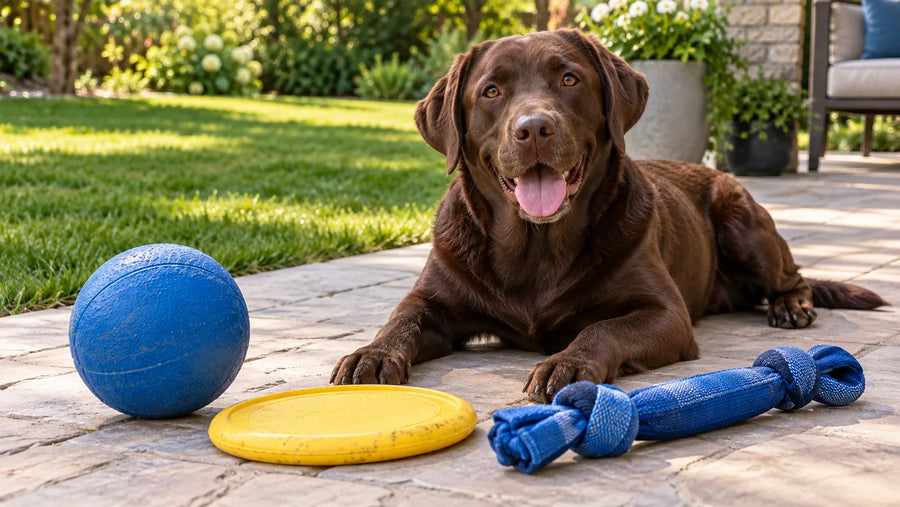
So a blue ball won't fix a dark play area. If your dog starts losing the toy as the sun goes down, add light, move somewhere brighter, or end the game.
For the colors dogs can distinguish in better light, see our dog color vision chart.
Why Do Dogs' Eyes Glow at Night?
That glow is reflected light. The tapetum sends light back toward a camera flash or another light source at the right angle. The eyes aren't producing light themselves.
The reflection's color can vary, and some dogs don't have the usual reflective layer. Its color doesn't tell you how good your dog's night vision is.
Don't repeatedly shine a flashlight into your dog's eyes to compare them. If the reflection changes over time or looks different between the eyes, the ACVO recommends having the eyes examined.
Do Dogs Need a Light on at Night?

Some dogs benefit from a night-light along a route they need to use. Others settle and move comfortably with the light already available. You don't need to keep the whole house brightly lit.
If your dog hesitates on the way to water or at a dim doorway, a gentle, steady light may help. Place it where it lights the floor without shining into their sleeping area.
Also check the setup:
- Keep the path free of bags, toys, and cords.
- Leave furniture and water bowls in familiar places.
- Make sure your dog has comfortable footing.
- Block access to stairs or drops when needed.
These changes can make the space easier to use. If the difficulty is new or getting worse, call your vet even if better lighting seems to help.
What If My Dog Is Having More Trouble After Dark?
Watch for a change from your dog's usual behavior. Are they stopping at a doorway they used to cross easily? Bumping into furniture? Avoiding a familiar route after sunset?
A 2023 study of dogs' vision found age-related differences in owners' reports of how their dogs managed in different lighting. It also included retinal testing in a smaller group of dogs. Trouble after dark still deserves attention: an observation at home can't tell you what's causing it.
Tell your vet when the difficulty happens, whether it's new, and whether you've noticed changes in daylight too. If your dog suddenly seems unable to see, seek urgent veterinary care. Sudden vision loss has several possible causes that require assessment, as the Merck Veterinary Manual explains.
Squinting, holding an eye closed, or a painful-looking eye also needs prompt attention. VCA's eye-care guidance lists signs owners should have checked.
Make Night Walks Easier for You and Your Dog
On an evening walk, think about three separate jobs: seeing the ground, making your dog visible to people, and keeping track of where they are.
| What you need | What can help |
|---|---|
| A route you can both navigate | Familiar, well-lit paths, a flashlight, and appropriate leash handling |
| A dog other people can see | Reflective or illuminated gear used as intended |
| Information about your dog's location | A suitable GPS collar used within its coverage and service requirements |
Reflective gear needs an outside light source, such as headlights or a flashlight. An illuminated accessory provides its own light. Check your gear before you leave, and keep your dog under appropriate control around traffic and wildlife.
If you're considering a GPS collar, our SATELLAI tracking guide explains the available location features. Check the requirements for your chosen model. A location reading can support your awareness of where your dog is; it doesn't show every hazard along the route.
Frequently Asked Questions
Do dogs have night vision like a camera?
Dogs' eyes are adapted to use dim light. They don't have a camera's infrared illumination, and they can't form a visual image without any light.
Can dogs see at night without a flashlight?
There may be enough ambient light for them to see. That depends on the route and the dog. Bring a light so you can check the ground and see what your dog is approaching.
Should I leave the TV on so my dog can see?
If your dog needs light along a walking route, a steady light source is more practical than a screen's changing glow. Keep the sleeping area comfortable.
Does good night vision make off-leash walks safe?
Eyesight alone doesn't determine that. Recall, traffic, wildlife, local rules, and your ability to supervise still matter. Use a leash or other appropriate control for the setting.