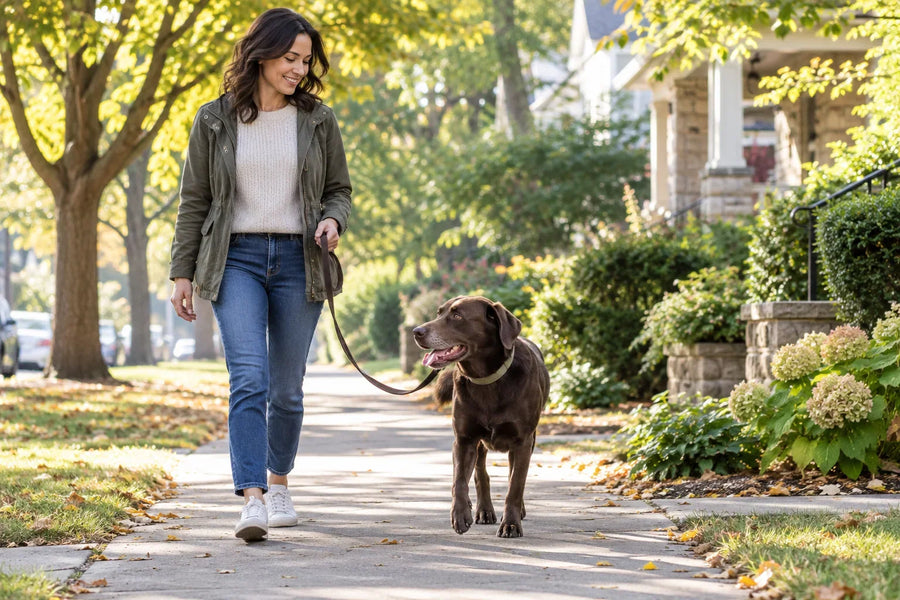
Before you buy a GPS tracker for your dog's harness, measure the strap where you plan to attach it. A buckle, padded section, or adjustment slider can get in the way—even when the strap width looks right.
Quick answer: Compare SATELLAI Collar Go for a compatible harness neck strap and two-way audio, Tractive DOG 6 for its clip that supports straps up to 30 mm wide, and Fi Mini for its 16 g tracker and two attachment options. The right choice depends on strap width, clear mounting space, and approved placement—not just app features. Don't adapt an integrated collar such as Fi Series 3+ or SATELLAI Collar into a harness mount.
Disclosure and selection: SATELLAI publishes this guide and sells Collar Go. We chose three options with official mounting instructions, reviewed October 19, 2026. This is a compatibility shortlist, not a tested market-wide ranking. The recommendations are not results of pull tests or escape testing; numbering does not indicate performance.
Harness GPS trackers: mounting limits at a glance
| Tracker | Why consider it? | Manufacturer's mounting requirements | Check before buying |
|---|---|---|---|
| SATELLAI Collar Go | Neck-strap mounting and Doggie-Talkie audio | Personal band up to 25 mm wide; compatible harness neck strap only | Backplate clearance and space to detach the tracker |
| Tractive DOG 6 | Supplied collar-and-harness clip | Maximum strap width: 30 mm / 3 cm | Flat mounting space, secure hooks, and clearance from buckles |
| Fi Mini | A 16 g tracker with two mounting options | Strap mount: 3/8–1 1/4 in wide; soft case: 1/2–1 1/4 in; at least 2 in of strap length | Correct attachment type and clear space between adjusters |
Sources: SATELLAI setup FAQ, SATELLAI model comparison, Tractive DOG 6 attachment instructions, and Fi Mini Overview.
1. SATELLAI Collar Go: for a compatible harness neck strap
SATELLAI Collar Go detaches from a quick-release backplate. SATELLAI's instructions allow it on a compatible collar or the neck strap of a harness, which can suit owners who want tracking and live audio without changing all their dog's equipment.
Keep it in the approved neck position. A chest panel, carry handle, or leash ring is not an interchangeable mounting point.
The setup FAQ limits your own band to 25 mm wide or less. Check thickness, too: folded webbing or padding may stop the backplate from sitting correctly even when the width is within that limit.
You'll still need to meet Collar Go's dog-fit requirements and activate a service plan. Moving a tracker to a harness doesn't make it suitable for a dog below its minimum size.
Review the current Collar Go requirements before choosing it. If a specific harness is uncertain, send its strap measurements and a photo of the intended mounting area to SATELLAI support before ordering.
2. Tractive DOG 6: for straps up to 30 mm wide
Tractive's DOG 6 getting-started guide covers collars and harnesses up to 3 cm wide using the supplied clip. It also shows a different threading method for narrow collars.
That gives you a slightly wider stated strap limit than Collar Go's 25 mm. It does not mean the clip will fit every padded 30 mm panel. Check the actual construction and make sure the hooks close as illustrated.
Once attached, check both sides of the clip. Turn the harness through its normal range of movement and look for contact with a buckle or ring.
Check the DOG 6 product page for dog-size requirements, location features, and service details. Avoid buying first and assuming an unverified third-party holder will solve a poor fit.
3. Fi Mini: for a lightweight add-on with two mount options
For harness mounting, look at Fi Mini rather than the integrated Fi Series 3+ collar. The two use different hardware and attachment systems.
Fi lists Mini at 16 g before attachments. You can use its strap mount or soft case, but their minimum widths differ. Choose the attachment as carefully as the tracker: a narrow strap that fits one may not fit the other.
Fi's overview, updated September 15, 2026, gives the mounting ranges in the table above. A harness-compatible attachment does not automatically mean every health metric is validated at every position.
The Mini overview also specifies at least two inches of strap length and excludes certain non-slip, buckle-free collars. Treat these as part of compatibility, not small print after purchase.
You'll need to slide Mini out of its attachment for USB-C charging. Fi also advises against using more than one attachment at a time. Make sure removal and refitting are easy enough to do without stretching the holder.
Before deciding on weight alone, consider what your dog will actually wear: tracker, mount, and harness together.

How to check whether a tracker fits your harness
A “medium” harness can have several different strap widths. Measure the approved mounting point, not the widest or easiest-to-reach section.
| Measurement or check | What to record | Why it can change the choice |
|---|---|---|
| Strap width | Width in millimeters or inches at the mounting point | Must be within the selected mount's permitted range |
| Clear strap length | Uninterrupted length between seams, rings, or adjusters | A wide enough strap may still have too little clear space |
| Thickness and padding | Single webbing, folded webbing, or padded construction | The mount must close and sit as designed |
| Moving hardware | Buckle, front clip, slider, or leash connector nearby | Contact may rotate the housing or obstruct removal |
| Dog movement | Walking, turning, sniffing, and lying down | Static fit can hide interference during use |
Keep the leash connected to an approved load-bearing point on the harness. The tracker mount is not a new leash connector.
If you're also checking collar fit, see our collar fit and safety guide. For this purchase, the key question is whether the tracker mount fits the equipment you already use.

The tracking gap most harness buyers overlook
What happens when the walk is over? If you hang the harness by the door, the tracker stays with the harness—not your dog. That's a problem if you also want an alert when your dog slips out at home.
Decide when you need tracking. If it's all day, check whether you can move the device to another approved setup and whether the change affects health or activity data.
Do not assume that a manufacturer supporting location tracking on a harness validates every health measurement at every mounting position. If a particular behavior or resting-health metric matters to you, confirm placement requirements for that metric separately.
An integrated collar may be more practical for some all-day routines. An attachable tracker may suit a dog whose equipment changes, provided you maintain a reliable transfer and attachment check.
Your first-week fit and tracking checklist
Complete this check while the dog remains physically controlled:
- Read the current attachment instructions for the exact tracker and mount.
- Fit the harness correctly before adding the tracker.
- Install the device in its approved position and confirm the latch or clip is engaged.
- Watch normal movement for rotation, contact with hardware, or pressure points.
- Take a short leashed walk and confirm that recent locations reach the app.
- Remove the tracker for charging and reinstall it correctly several times.
- Check where the tracker will be when the harness is removed at home.
If the device shifts repeatedly, choose a different approved arrangement or another tracker. Extra tape and improvised ties should not substitute for compatibility.
Which option should you buy?
Choose around your harness first. Collar Go is an option for a compatible neck strap when you also want two-way audio. DOG 6 is worth checking for a strap up to 30 mm wide. Fi Mini is worth checking when a small, light add-on is the priority and one of its mounts fits.
The best purchase is the setup you can attach correctly every time, remove for maintenance, and keep with the dog during the situations you are trying to cover.
What this shortlist does—and doesn't—cover
We compared official mounting limits, attachment methods, and charging access. We did not fit the trackers to identical harnesses or measure retention strength, and these three options do not cover the entire market. Width is a starting point; thickness, hardware clearance, approved position, and the dog's movement still need checking.
Frequently asked questions
Can every GPS dog collar attach to a harness?
No. Integrated collar systems and attachable trackers are different designs. Use only mounting methods approved for the exact device.
What strap width does Tractive DOG 6 support?
Tractive's DOG 6 instructions specify collars and harnesses up to 3 cm / 30 mm wide with the supplied clip. Width alone does not guarantee a fit: padding, seams, and buckles can interfere with the mount.
Can SATELLAI Collar Go go anywhere on a harness?
No. SATELLAI describes Collar Go as neck-worn, on a compatible collar or harness neck strap. Its personal-band limit is 25 mm wide. Don't assume a handle or chest panel is an approved alternative.
Will a harness-mounted GPS tracker still work when I take the harness off?
The tracker may still report a location, but it will be the equipment's location. It cannot tell you where the dog went after they separated.
Do I have to remove Fi Mini to charge it?
Yes. Fi's instructions say to remove Mini from its strap or soft case to reach the USB-C port. A Fi Base can support a connection at home, but it does not charge Fi Mini.