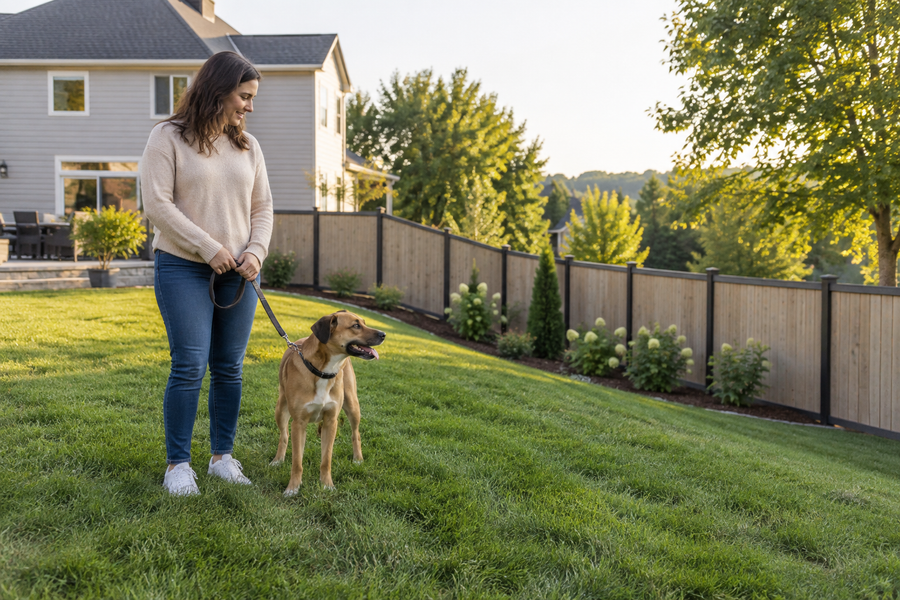
Some dogs only need a gate left open for a second. Others dig under fences, climb over barriers, back out of a loose collar, or follow an interesting scent until home is far behind them. If your dog keeps escaping, the pattern is stressful—but it also gives you useful clues about how to make them safer.
A GPS dog collar can provide an earlier warning and a faster way to locate a dog that has already left a safe area. It cannot physically stop the escape. The most effective plan uses tracking technology as one layer alongside secure handling, identification, training, and changes to the environment.
At a Glance
- Best role for a GPS collar: alerting you when your dog leaves a defined area and helping you follow their current location.
- What it cannot do: replace a physical fence, leash, supervision, recall training, ID tag, or microchip.
- Features that matter most: fast escape alerts, useful live-location updates, dependable coverage, secure fit, location history, water resistance, and a realistic charging routine.
- Best first step: identify exactly how and why your dog escapes, then fix that failure point before relying on technology.
Why Does My Dog Keep Escaping?
Dogs do not all run away for the same reason. One dog may slip through a damaged gate to explore; another may panic during fireworks; another may dig because the yard offers too little stimulation. The right response depends on the trigger and the escape route.
| Likely reason | What you may notice | First response |
|---|---|---|
| A gate or fence gap | Escapes from the same location | Repair the gap and secure every latch |
| Digging | Holes along the fence line | Block access, reinforce the fence base, and supervise yard time |
| Jumping or climbing | Scratches or disturbed areas near the top of the fence | Remove climbing aids and review fence height and design |
| Prey or scent drive | Bolting after wildlife or following a trail | Use secure handling and practice recall around controlled distractions |
| Boredom or excess energy | Pacing, digging, chewing, or repeated attempts to leave | Add exercise, sniffing activities, training, and interactive play |
| Fear or noise sensitivity | Escape attempts during storms, fireworks, or construction | Bring the dog indoors and create a secure, quiet space |
| Separation-related distress | Attempts occur when the dog is left alone | Speak with a veterinarian or qualified behavior professional |
| Loose gear | The dog backs out during walks | Recheck fit and consider more secure, appropriately fitted equipment |
The American Kennel Club recommends addressing the specific exit route, securing gate latches, supervising dogs outdoors, and considering measures such as a double-gate entry for determined escape artists. See its yard escape-prevention guidance for additional examples.
Some breeds and individual dogs are naturally more independent, driven to chase, or motivated to roam. Our guide to dog breeds most likely to escape explains how breed tendencies can influence behavior without determining what every individual dog will do.

How Can a GPS Dog Collar Help an Escape-Prone Dog?
A modern GPS tracker estimates a dog’s location from satellite signals and generally uses a wireless connection—often cellular—to send that information to an app. If you are new to the technology, start with what a GPS dog collar is and how it works.
For a dog that runs away, four functions are especially useful.
1. Escape Alerts
You create a virtual boundary around a home, yard, apartment building, boarding location, or another familiar area. When the device detects that your dog has moved outside that zone, the app can send an alert.
An escape alert can reduce the time between the dog leaving and the owner beginning to respond. That matters because a moving dog may cover more ground while no one realizes the gate is open.
2. Live Location Tracking
Once you know your dog is outside the expected area, Live Tracking Mode can provide more frequent location updates. This is more useful during an active search than a map point that refreshes only occasionally.
Update speed is only one part of performance. Buildings, tree cover, terrain, network availability, device settings, and battery level can all affect the location information you receive.
3. Location History
Location history may show the direction your dog traveled or reveal repeated escape patterns. If the same dog repeatedly heads toward a neighbor’s yard, a trail entrance, or a gap in the fence, that pattern can help you improve the prevention plan.
4. Light and Voice Features
Some smart collars include a controllable light or audio feature. A light may make a dog easier to see after dark. A familiar, previously practiced voice cue may help get the dog’s attention, although audio should never be treated as a guaranteed recall.
What a GPS Collar Cannot Do
This distinction is essential: a tracking boundary is not a physical barrier. A dog can still cross the line, enter traffic, approach another animal, or move into an area with poor cellular coverage.
A GPS dog collar also cannot:
- Repair a broken fence or close an open gate
- Prevent a dog from backing out of loose equipment
- Guarantee uninterrupted positioning or app updates in every environment
- Work reliably when it is uncharged, removed, damaged, or outside supported coverage
- Replace training for fear, anxiety, recall, or repeated roaming
- Replace permanent identification if the collar comes off
For a fuller look at these limitations, read Do GPS Dog Collars Work? Benefits & Limitations.
GPS Tracker, Fence, ID Tag, or Microchip: Which Does Your Dog Need?
These tools solve different parts of the problem, so they work best as a layered system.
| Safety layer | Main purpose | Important limitation |
|---|---|---|
| Physical fence or closed door | Helps contain the dog | Can fail through gaps, digging, climbing, or human error |
| Leash and secure collar or harness | Provides direct control during walks and transfers | Must fit correctly and remain in the handler’s control |
| GPS dog collar | Provides escape alerts and current location information | Depends on power, fit, signal, connection, and coverage |
| Visible ID tag | Lets a finder contact the owner quickly | Can become unreadable or separate from the dog |
| Registered microchip | Provides permanent scannable identification | Does not show the dog’s live location |
The American Veterinary Medical Association explains that a microchip provides permanent identification that cannot be lost in the same way as a collar or tag. Keep the registration details current and use it alongside—not instead of—visible identification and GPS tracking. Review the AVMA microchipping FAQ or our comparison of a microchip and GPS dog collar.
Features to Look for in a GPS Collar for a Dog That Runs Away
The longest feature list is not necessarily the safest choice. Focus on the functions that affect how quickly you can notice and respond to an escape.

Fast, Configurable Escape Alerts
Check whether the tracker lets you create boundaries that match the places your dog actually visits. A useful alert should arrive promptly enough to act on, and the boundary should not be so small or inaccurate that routine movement produces constant false alarms.
Useful Live-Tracking Frequency
For an active search, frequent updates make it easier to understand whether the dog is moving and in which direction. Compare the actual update interval in the product’s live mode rather than relying only on the phrase “real time.”
Coverage Where You Live
Many pet GPS devices use satellites to calculate location and LTE or another network to transmit that location to your phone. Check supported coverage around your home, neighborhood, dog park, vacation property, and usual travel routes.
Secure, Comfortable Fit
A tracker cannot help if it falls off. Check the dog’s weight, neck measurement, band compatibility, device dimensions, and attachment system. A well-fitted collar should be secure without restricting breathing or normal movement. The AKC’s current guidance for dogs that get loose recommends updated identification and a fit that allows two fingers beneath the collar without excessive looseness.
Battery Life That Fits Your Routine
Maximum battery claims are useful for comparison, but real runtime can change with tracking mode, signal conditions, temperature, and feature use. Choose a charging schedule that leaves a safety margin. A long claimed battery life does not help if the device is routinely left at 5%.
Water and Dust Resistance
An escaping dog may run through wet grass, rain, mud, or shallow water. Check the manufacturer’s current water-resistance instructions and inspect the device and attachment after rough activity.
Is SATELLAI Collar Go a Good Fit for an Escape Artist Dog?
The SATELLAI Collar Go is designed for lightweight everyday location awareness around neighborhoods, parks, trips, and other areas with supported connectivity. Its escape-related features include:
- Customizable virtual boundaries and in-app escape alerts
- Location updates every 2–3 seconds in Live Tracking Mode
- Location history and heatmap information
- Two-way audio and prerecorded voice commands
- An app-controlled night safety light
- A built-in NFC tag that can help a finder leave contact information
- A 1.7 oz (47 g) device weight
- IP68 water and dust resistance
- Up to 4.5 days of maximum battery life
Connected GPS tracking, virtual boundaries, and related app features require an active telecom plan. Actual battery life and tracking performance vary with mode, use, environment, coverage, and other conditions.
Collar Go is best understood as an awareness and recovery tool—not an escape-proof fence. It can be a strong fit for everyday escape risks such as an open apartment door, a neighborhood gate, a dog sitter’s yard, or a dog that slips away during travel. Owners managing large properties who want a boundary-focused system should separately compare Collar Go with the full-size SATELLAI Collar.
How to Set Up a GPS Collar Before an Escape Happens
Do not wait for an emergency to learn how the app works.
- Charge and activate the device. Confirm that the required plan and app connection are active.
- Check the fit and attachment. Make sure the tracker cannot rotate excessively, snag easily, or slide over the dog’s head.
- Create realistic safe zones. Set boundaries around the actual permitted area instead of drawing the smallest possible circle.
- Test the alert. Walk the device across the boundary yourself and confirm that notifications appear on the phones you rely on.
- Practice Live Tracking Mode. Learn where to switch modes and how the map changes before your dog is missing.
- Teach a positive return cue. Practice recall with rewards in controlled environments. If the collar has audio, introduce the sound or recorded cue during training rather than for the first time during an escape.
- Create a charging routine. Charge on a schedule tied to something you already do, then check the battery before yard time, travel, or a dog sitter handoff.
- Keep identification current. Update the ID tag, microchip registration, NFC profile, and recent photos.
How to Reduce Repeat Escapes
A tracker helps you respond, but prevention begins with the reason your dog leaves.
Inspect the Environment
Walk the entire boundary at your dog’s eye level. Look for loose boards, spaces under gates, climbable objects near fences, damaged screens, and latches that children or wind can open. For a digger, focus on the fence base. For a jumper, remove launch points and consult a qualified professional about safe structural changes.
Supervise High-Risk Moments
Doorways, visitors, deliveries, car transfers, fireworks, storms, and unfamiliar locations deserve extra control. Use a leash even in a fenced area when an unusual trigger makes bolting more likely.
Meet Exercise and Enrichment Needs
Walks, sniffing, food puzzles, play, and short training sessions can reduce boredom-driven attempts. More exercise alone is not a cure for fear or separation-related distress, so match the response to the cause.
Strengthen Recall Without Punishing the Return
Reward the dog for coming back. If returning always ends in anger or punishment, the dog may become less willing to approach the next time. Practice at safe distances with a long line and gradually add controlled distractions.
Get Professional Help When Needed
Sudden roaming, panic, destructive escape attempts, or separation-related behavior may require veterinary or behavioral support. A qualified professional can help rule out medical problems and create a humane behavior plan.
What Should You Do If Your Dog Gets Loose?
- Open the tracking app and confirm the most recent location and timestamp.
- Switch to the fastest appropriate tracking mode if available.
- Check the direction of travel instead of driving only to an old map point.
- Bring a leash, high-value treats, and something familiar to the dog.
- Use a calm, practiced recall cue; frantic chasing may push a frightened or excited dog farther away.
- Ask someone to check home and the original escape point in case the dog returns.
- If tracking is lost, contact nearby shelters, veterinary clinics, animal control, neighbors, and local lost-pet networks.
- After recovery, check the dog for injury and determine how the escape happened before restoring the same routine.

Frequently Asked Questions
Can a GPS collar stop a dog from escaping?
No. A standard GPS tracker can alert you when a dog leaves a safe zone and help show the dog’s location, but it does not create a physical barrier. Even a GPS virtual-fence system should be combined with training, supervision, identification, and appropriate physical control.
What is the best GPS tracker for a dog that runs away?
Look for fast escape alerts, sufficiently frequent Live Tracking updates, coverage in the places your dog travels, a secure and comfortable fit, useful location history, water resistance, and battery life that works with your charging habits. The best tracker is the one that remains charged, attached, connected, and comfortable on your individual dog.
Will a GPS collar work if my dog runs into the woods?
It may, but dense tree cover, terrain, valleys, weak cellular service, and other conditions can reduce or delay location updates. Test the device in the environments where you expect to use it and keep a leash, ID tag, and microchip as additional safety layers.
Is an escape alert the same as a virtual fence?
An escape alert tells you that the tracker has left a mapped area. Some products use “virtual fence” to describe that alert zone, while others add boundary-training features. Read the product description carefully and never assume a line on a map physically contains a dog.
Does my dog still need a microchip if they wear a GPS collar?
Yes. A microchip provides permanent identification if the collar or tracker comes off, while a GPS collar provides active location information when charged and connected. They perform different jobs and are more useful together.
How tight should a GPS dog collar be?
It should be secure enough that the dog cannot back out and the device does not swing excessively, but it must not interfere with breathing, swallowing, or normal movement. Follow the manufacturer’s sizing instructions and recheck the fit as the dog grows, gains or loses weight, or changes coat thickness.
Final Takeaway
When a dog keeps escaping, the goal is not to buy a gadget and ignore the cause. Fix the route, manage the trigger, strengthen safe habits, and use GPS tracking as an additional layer of awareness.
For everyday escape-prone dogs in supported coverage areas, SATELLAI Collar Go combines customizable boundaries, escape alerts, Live Tracking, location history, a night light, and voice tools in a lightweight device. Used alongside secure fencing, supervision, a leash, visible identification, and a registered microchip, it can help owners notice an escape sooner and make a more informed search.