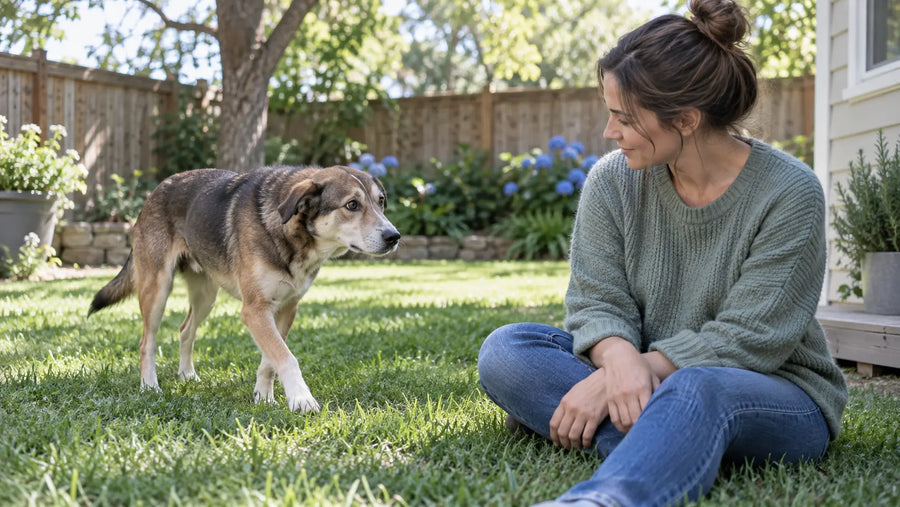
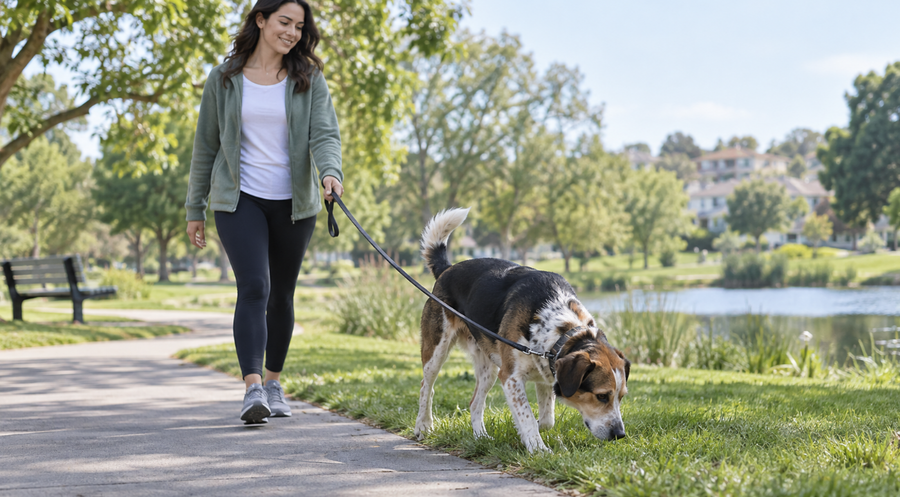
A dog anxiety trigger is something that predicts danger or discomfort to that individual dog. Common triggers include loud sounds, separation, unfamiliar people, other dogs, handling, travel, confinement, changes in routine, and pain.
Triggers are individual. One dog may sleep through a thunderstorm while another begins pacing before the first loud clap. A busy sidewalk may excite one dog and overwhelm another. Identifying the trigger requires looking at what happened before the behavior, how close or intense the situation was, and how long the dog took to recover.
Quick answer: When your dog shows anxiety, create distance and reduce pressure first. Record the situation, intensity, early body-language signals, and recovery time. Prevent repeated overwhelming exposure, rule out medical contributors, and use gradual reward-based training below the dog's panic threshold.
Trigger, Fear Response, and Anxiety Are Not the Same
A trigger is the event, object, place, sensation, or prediction associated with concern. Fear is a response to a perceived immediate threat. Anxiety is anticipation that something threatening may happen.
For example, thunder may be the trigger. Trembling and hiding during a loud clap may reflect fear. Pacing when the sky darkens, before thunder begins, may reflect anxiety based on previous experience.
The behavior is communication, not proof that a dog is stubborn, guilty, dominant, or deliberately difficult.
Common Signs a Dog Is Approaching Their Limit
Early signs are often quieter than barking or lunging. Look for combinations of:
- Turning the head or body away
- Closing the mouth suddenly
- Lip licking when food is not present
- Repeated yawning
- Ears held back
- A lowered or rigid posture
- Freezing or slowing down
- Refusing treats normally accepted
- Scanning, pacing, panting, or trembling
- Hiding or trying to escape
No single behavior diagnoses anxiety. Panting may follow exercise, yawning may reflect tiredness, and food refusal may have a medical cause. Context, clusters of signals, and change from the dog's normal behavior matter.
Our guide to reading signs of stress in dogs explains these signals in more detail.
1. Loud or Unpredictable Sounds
Thunder, fireworks, construction, alarms, gunshots, household appliances, and vehicle noise can trigger fear. Some dogs react to volume, while others respond to vibration, flashes, changes in air pressure, or the unpredictability of the sound.
Management may include moving to an interior room, closing curtains, using steady background sound, planning bathroom breaks before fireworks begin, and checking doors and gates. Do not take a frightened dog outside without secure physical control.
Recorded sounds are sometimes used for gradual desensitization, but real storms include sensations a recording cannot reproduce. Begin at a very low intensity and stop if the dog becomes tense or cannot eat.
2. Being Left Alone
Some dogs struggle specifically when a person prepares to leave or becomes unavailable. Possible triggers may include picking up keys, putting on work shoes, closing an interior door, or a change from constant company to a full workday.
Separation-related distress is not revenge. A dog that vocalizes, soils the home, damages exits, drools, or panics after departure may need a veterinary assessment and an individualized behavior plan.
Video can help identify when the behavior begins and whether the dog settles. Avoid repeatedly testing longer absences when the dog is already panicking.
3. Unfamiliar People
Concern may be triggered by direct eye contact, reaching, leaning over the dog, hats, mobility devices, unusual movement, or a person entering the home. The trigger may be a particular action rather than all unfamiliar people.
Ask visitors to ignore the dog initially. Provide distance and access to a protected resting area. Do not lure the dog close enough to take food if doing so leaves the dog trapped beside the visitor.
4. Other Dogs or Animals
A dog may react to direct approaches, staring, barking behind fences, crowded parks, off-leash dogs, or animals of a particular size or play style.
Create distance before the dog becomes unable to respond. Cross the street, use parked cars as visual barriers, choose quieter walking times, and skip chaotic greetings. Socialization does not mean forcing interaction with every dog.
5. Handling, Grooming, and Veterinary Care
Nail trims, ear care, brushing, injections, restraint, and examination can become triggers after discomfort or loss of control. Pain may also make previously accepted handling difficult.
Break care into small cooperative steps. Reward looking at an item, approaching the station, offering a paw briefly, or tolerating a moment of gentle touch. Stop before distress escalates.
Urgent medical care cannot always proceed slowly, so tell the veterinary team about previous fear before the appointment. They may recommend a lower-stress visit plan or prescribed medication. Never give human medication without veterinary direction.
6. Travel and Vehicle Rides
Car anxiety may involve motion sickness, engine noise, unstable footing, restraint, or learned anticipation of an unpleasant destination. Signs can include drooling, panting, whining, vomiting, refusal to enter, or frantic movement.
Ask a veterinarian about possible motion sickness. For behavior work, begin with easier steps such as approaching the parked vehicle, sitting inside briefly with the engine off, or taking a very short trip to a neutral or enjoyable location.
7. Changes in Environment or Routine
Moving, renovations, a new baby, a new pet, a family member leaving, altered work hours, or loss of a familiar walking route can change a dog's sense of predictability.
Preserve familiar meals, bathroom breaks, beds, and low-pressure activities when possible. Introduce new routines gradually and provide more recovery time after busy days.
8. Confinement or Feeling Trapped
Closed crates, narrow hallways, tight leash greetings, blocked doorways, crowded elevators, or being held during interaction can trigger fear in dogs that feel unable to leave.
Do not block escape simply to make the dog “face” the situation. Provide a clear exit and use gates, distance, or visual barriers for safety. A crate can be comfortable for a dog trained to enjoy it, but it may intensify panic in a dog with confinement distress.
9. Pain, Illness, and Sensory Change
A physical problem can create a new trigger or lower a dog's tolerance. Arthritis may make slippery floors frightening. Ear pain may make head handling difficult. Vision loss may cause surprise when someone approaches. Digestive or skin discomfort may contribute to restlessness and irritability.
The Merck Veterinary Manual emphasizes ruling out medical contributors when behavior changes. Sudden fear, aggression, withdrawal, or handling sensitivity warrants veterinary attention.
How to Keep a Dog Trigger Journal
A short record can reveal patterns that memory misses. For each event, note:
- Date and time
- Location
- What happened immediately before the response
- Distance or intensity
- Earliest body-language change
- Most intense behavior
- Whether the dog could eat or respond
- What helped
- How long recovery took

Record ordinary days too. Without a baseline, it is difficult to know whether activity, sleep, or behavior has meaningfully changed.
Management Comes Before Training
Management reduces exposure while the dog learns. It is not failure or avoidance without purpose.
Useful management may include:
- Increasing distance from the trigger
- Changing walking time or route
- Using curtains or visual barriers
- Giving visitors clear instructions
- Providing a quiet, protected resting area
- Preventing unsupervised access to gates and doors
- Using a leash, secure fence, or gate where safety requires it
A GPS device or escape alert can provide an additional safety layer, but it cannot prevent panic, replace a leash or physical barrier, or treat anxiety.
Use Gradual Desensitization and Counterconditioning Carefully
Desensitization introduces a trigger at an intensity low enough for the dog to remain comfortable. Counterconditioning pairs that manageable exposure with something the dog values.
For example, a dog concerned about a vacuum may begin with the vacuum switched off across the room. Calmly noticing it may predict food. Later sessions might include small changes in position or very brief sound at a distance.

Progress is not measured by how close the dog can be forced to stand. It is measured by relaxed behavior and recovery. If the dog freezes, hides, lunges, tries to escape, or refuses normally valued food, the session is too difficult.
The American Veterinary Society of Animal Behavior recommends reward-based training and behavior modification rather than methods that add fear or discomfort.
What Not to Do
- Do not punish growling, hiding, trembling, barking, or escape attempts.
- Do not trap the dog near the trigger.
- Do not flood the dog with intense exposure in the hope that fear will disappear.
- Do not use food to lure the dog into a distance it would not choose.
- Do not assume every reaction is purely behavioral before considering health.
- Do not increase difficulty simply because the dog succeeded once.
When to Seek Professional Help
Start with a veterinarian when anxiety is new, severe, worsening, or accompanied by physical changes. Seek prompt help when the dog injures itself, cannot eat or rest, panics during brief absences, or shows aggression that creates a safety risk.
A board-certified veterinary behaviorist or qualified reward-based behavior professional can help identify triggers, set safe thresholds, and create a structured plan. Medication may be appropriate in some cases, but it must be selected and monitored by a veterinarian.
For broader signs and next steps, read how to tell if your dog has anxiety.
Frequently Asked Questions
What are the most common dog anxiety triggers?
Common triggers include loud sounds, separation, unfamiliar people, other dogs, handling, travel, confinement, environmental changes, and pain. The exact trigger and tolerable intensity vary by dog.
How can I identify my dog's trigger?
Record what happened before the behavior, the distance or intensity involved, the dog's earliest signals, and recovery time. Repeated patterns are more useful than one isolated reaction.
Should I expose my dog to a trigger until they get used to it?
No. Intense, unavoidable exposure can worsen fear. Controlled exposure should remain low enough for the dog to stay comfortable and should be increased gradually.
Can pain make a dog appear anxious?
Yes. Pain, illness, sensory loss, and other physical changes can cause restlessness, avoidance, sensitivity, or aggression. Sudden behavioral change should be discussed with a veterinarian.
Can I punish my dog for reacting to a trigger?
No. Punishment may add another source of fear and suppress warning signals without changing the underlying emotion. Create safety and use reward-based behavior work instead.
The Bottom Line
Understanding dog anxiety triggers begins with observation, not labels. Identify what happens before the response, notice early signals, and track how intensity and distance affect behavior.
Reduce immediate pressure, prevent repeated overwhelming experiences, and make behavior work gradual enough for the dog to remain comfortable. When behavior changes suddenly or creates a welfare or safety concern, involve a veterinarian and qualified behavior professional.
Sources
- Merck Veterinary Manual: Behavior Problems of Dogs
- American Veterinary Society of Animal Behavior: Position Statements