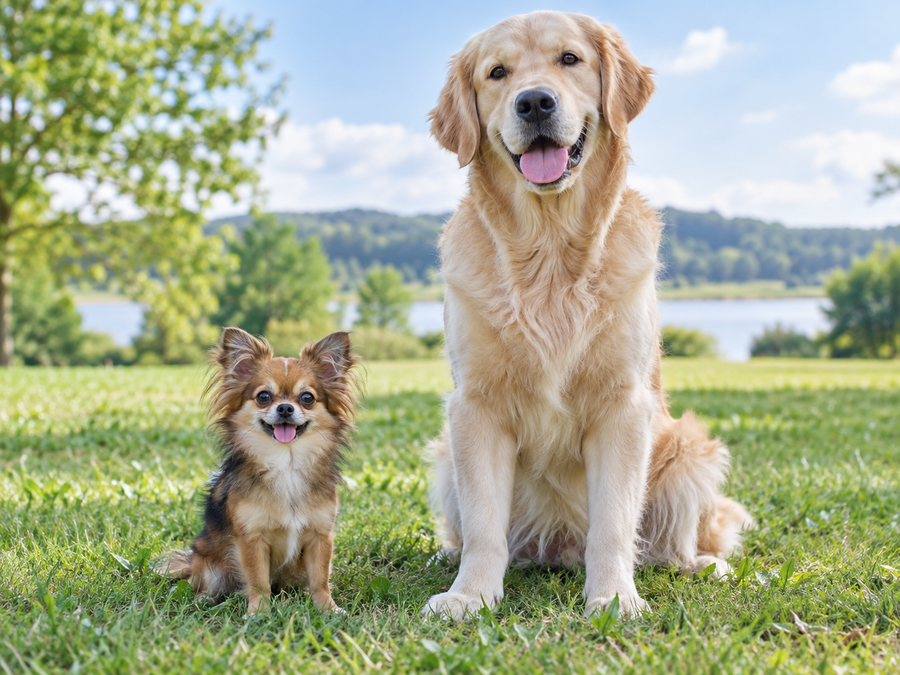
A dog's size affects more than how much space they take up on the couch. It is also closely connected with how quickly they move through later life, when they may be considered senior, and how long they tend to live on average.
Small and giant dogs can share the same chronological age while being at very different points in their biological life stage. That is one reason a useful dog-age estimate should consider adult body size rather than applying the same formula to every dog.
If you want to see how size changes your dog's estimated human age, try the SATELLAI Dog Age Calculator.
Quick Answer: Does Dog Size Affect Aging?
Yes. Larger dogs generally have shorter average lifespans and tend to reach their senior years earlier than smaller dogs. The difference becomes especially noticeable after early adulthood. Body size is not the only factor involved—breed genetics, health, body condition, nutrition, and veterinary care matter too—but size is one of the clearest broad predictors of canine lifespan.
The American Animal Hospital Association (AAHA) does not assign one fixed senior age to every dog. Instead, it defines the senior stage as approximately the final 25% of a dog's estimated lifespan, which naturally makes breed and body size important. You can read more in AAHA's senior life-stage guidance.
Why Do Small and Large Dogs Age Differently?
The pattern is unusual when compared with many other mammals. Across species, larger animals often live longer. Within domestic dogs, however, the relationship tends to reverse: larger dogs generally have shorter lifespans than smaller dogs.
Researchers have proposed several explanations, including rapid early growth, differences in metabolic demands, genetic factors, and differences in age-related disease risk. No single mechanism explains every breed, but studies consistently show that body size is strongly associated with canine longevity.
A large clinical dataset published in Scientific Reports found that life expectancy at birth decreased as dog size increased. In that dataset, giant dogs had substantially shorter average life expectancy than small dogs. The full study is available through PubMed Central.
How Size Changes a Dog's Life Stage
Dogs do not move through life stages on the same timetable. A small dog may remain a mature adult at an age when a giant dog is already considered senior.
AAHA defines the mature adult stage as the period between physical and social maturity and the final 25% of expected lifespan. The senior stage begins during that final portion of life. Because predicted lifespan is breed- and size-dependent, the transition into senior life varies considerably between dogs.
This is more useful than saying every dog becomes senior at seven years old. A seven-year-old Chihuahua, Labrador Retriever, and Great Dane should not automatically be treated as being in the same biological stage.
For a closer look at this transition, read When Does a Dog Become a Senior?.
Small Dogs: Slower Aging Later in Life
Small dogs often live well into their teens. Their first year is still a period of rapid development, but later aging generally progresses more slowly than it does in large and giant dogs.
This does not mean a small dog stays biologically young forever. Small dogs can still develop arthritis, dental disease, sensory loss, cognitive changes, heart disease, and other age-related conditions. The difference is that these later-life stages often occur at an older chronological age.
Medium Dogs: Somewhere in the Middle
Medium-sized dogs often fall between small and large breeds in both lifespan and the timing of senior status. Their aging pattern can vary substantially depending on breed and genetics, which is why body size works best as a broad guide rather than a precise biological clock.
A healthy medium-sized dog may remain active well into later adulthood, while another dog of the same size may experience health or mobility changes earlier.
Large Dogs: Earlier Senior Transitions
Large dogs tend to reach later life stages sooner than small dogs. Their chronological age may not look especially high, but their body may already be experiencing changes associated with senior life.
For pet parents, this means paying attention to mobility, exercise recovery, body condition, sleep, and behavior before waiting for a particular birthday.
If you are noticing subtle changes already, our guide to how dogs change as they get older explains common physical and behavioral signs to watch.
Giant Dogs: Faster Aging After Adulthood
Giant breeds are at the extreme end of the size spectrum. They undergo dramatic growth during puppyhood and tend to have shorter average lifespans than smaller dogs.
A study examining energy use, growth, and lifespan across 90 dog breeds found that the relationship between birth mass and adult mass may help explain why larger dogs have shorter lifespans. The researchers proposed that the greater energetic demands of growth in large breeds may involve trade-offs with long-term maintenance. Read the study on PubMed Central.

Does Size Change a Dog's Human-Age Equivalent?
It should, especially after the first couple of years.
The old idea that one dog year equals seven human years treats every dog identically. That is convenient, but biologically it does not make much sense. Dogs mature rapidly early in life, and later aging differs by size.
A seven-year-old small dog may still be a mature adult, while a giant dog of the same chronological age may already be senior. Giving both dogs the exact same human-age equivalent hides that difference.
That is why the SATELLAI Dog Age Calculator separates adult dogs into Small, Medium, Large, and Giant size groups when estimating human age.
Is Size More Important Than Breed?
Size is important, but breed adds another layer.
Two breeds with similar body weights can still have different average lifespans because genetics and disease risks differ. Some breeds are more predisposed to certain cardiac, orthopedic, neurological, or cancer-related conditions.
That means size should be treated as a useful starting point rather than the only predictor of aging.
Size Is Not the Same as Body Condition
A genetically large dog and an overweight dog are not the same thing.
Adult size mostly reflects breed and skeletal structure. Body condition describes whether a dog is underweight, at an appropriate weight, or carrying excess body fat.
Maintaining an appropriate body condition matters at every size. In the large life-expectancy study mentioned earlier, obesity was associated with lower life expectancy than ideal body condition. That does not mean weight alone determines lifespan, but it reinforces the importance of healthy weight management.
What Should Pet Parents Do Differently Based on Size?
The goal is not to treat large dogs as old before their time or assume small dogs do not need age-related care. Instead, use size to decide when to start watching more closely for change.
For large and giant dogs, it can be useful to monitor mobility, recovery after exercise, body condition, and routine changes earlier in adulthood. For small dogs, senior changes may appear later, but regular preventive care remains important.
Regardless of size, AAHA recommends individualized care based on the dog's health, environment, behavior, and life stage rather than relying on chronological age alone.
Final Takeaway
Dog size has a meaningful relationship with aging and lifespan. Small dogs generally reach senior life later and live longer on average, while large and giant dogs tend to move through later life more quickly.
But size is only one part of the picture. Breed, genetics, weight, disease risk, activity, nutrition, preventive care, and individual health all influence how a dog ages.
Use body size as context rather than a deadline. To get a general estimate of where your dog may be in the aging process, start with the SATELLAI Dog Age Calculator and then compare the result with your dog's actual activity, mobility, behavior, and veterinary history.

Frequently Asked Questions
Do bigger dogs age faster than smaller dogs?
In general, yes. Larger dogs tend to have shorter average lifespans and reach their senior stage earlier than smaller dogs, particularly after early adulthood.
At what age is a large dog considered senior?
There is no universal cutoff. Large dogs often enter their senior years earlier than small dogs, and AAHA recommends considering senior status in relation to the final 25% of expected lifespan.
Why can two dogs of the same age be at different life stages?
Body size, breed, genetics, health, and expected lifespan all influence aging. Chronological age alone does not fully describe a dog's biological stage.
Does dog size affect human-age calculations?
Yes. Size becomes particularly relevant after early adulthood because small and large dogs do not age at the same rate later in life.
What is the easiest way to estimate my dog's human age?
Use the SATELLAI Dog Age Calculator, which considers both chronological age and adult body size.