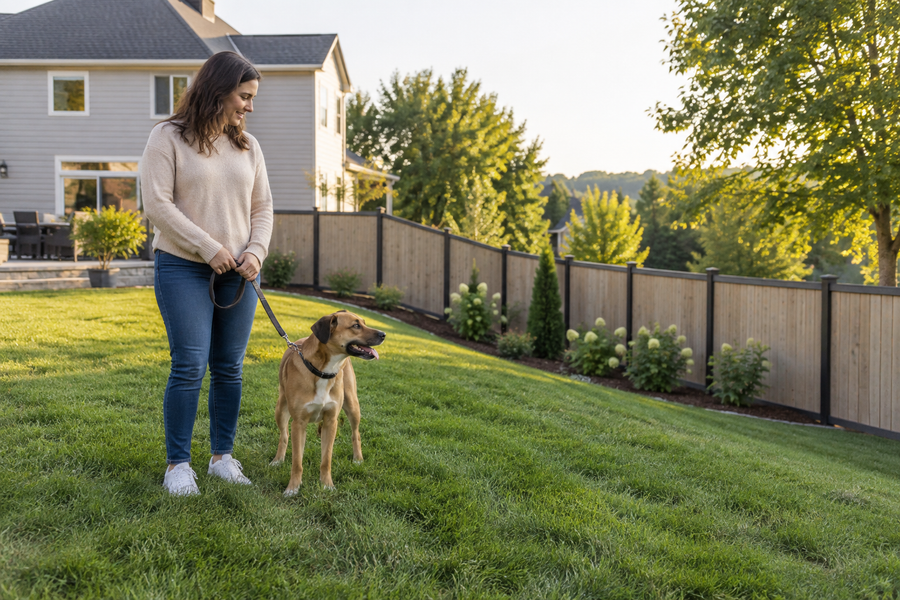
Yes, GPS dog fences can work on suitable properties when positioning is reliable, the boundary leaves a meaningful safety buffer, and the dog completes consistent training. However, they are not physical barriers and cannot guarantee containment. Performance depends on the collar, property layout, satellite visibility, cellular coverage, battery status, setup, and the individual dog.
That qualified “yes” matters. A GPS fence for dogs can provide flexible boundary guidance and escape awareness, but it should never be marketed as an invisible wall that no dog can cross.
30-Second Answer
GPS dog fence systems are most likely to work well when:
- The property is large enough to place the virtual line safely inside roads, water, cliffs, and neighboring land.
- The collar has a relatively clear view of the sky.
- Cellular coverage supports the model’s connected alerts and tracking features.
- The battery is charged and the collar fits correctly.
- The owner tests the full boundary before relying on it.
- The dog learns the boundary through calm, reward-based training.
They are more likely to struggle in small or narrow yards, beside immediate hazards, under dense canopy, near tall buildings, or when a dog is likely to bolt through a warning.
What Does “Work” Mean for a GPS Dog Fence?
Before judging whether GPS fences for dogs work, define the job the system is supposed to do.
A well-functioning system may be able to:
- Determine the receiver collar’s outdoor location.
- Compare that location with a saved geofence for dogs.
- Provide a configured cue as the dog approaches a boundary.
- Notify the owner when a crossing is detected.
- Help the owner follow the dog’s location after an escape, when tracking and network service are available.
It cannot:
- Create a physical wall
- Guarantee that every dog will stop
- Keep wildlife, roaming dogs, or people out
- Work when the device is uncharged, damaged, removed, or unable to determine location
- Replace supervision, identification, recall training, or secure containment where those are needed
Success should mean useful, repeatable boundary support—not a promise that escape is impossible.
How Do GPS Dog Fences Work?
In simple terms, a GPS-enabled receiver collar calculates its position from navigation satellite signals and compares that position with a digital boundary saved in the system. Depending on the model and settings, the collar may provide a tone, vibration, or another configured response near the line. Cellular service may then send location updates and alerts to the owner’s phone.
That is intentionally brief because this article evaluates real-world effectiveness. For a complete technical explanation, read How Does a GPS Dog Fence Work?.
When Do GPS Dog Fences Work Best?
The strongest use cases generally combine enough space, good signal conditions, and consistent owner involvement.
| Condition | Why it matters |
|---|---|
| Open outdoor space | A clearer view of the sky generally supports more consistent satellite positioning. |
| Enough room for a buffer | The digital boundary can sit well inside roads, water, cliffs, driveways, or neighboring property. |
| Stable supported cellular coverage | Connected collars can send alerts, location updates, and history more reliably. |
| A tested boundary layout | Walking the perimeter can reveal weak areas before the dog depends on the system. |
| A reliable charging routine | A dead receiver collar cannot provide an active electronic boundary or current location. |
| Reward-based boundary training | The dog learns that the warning predicts a return to the safe zone. |
| Ongoing supervision | The owner can respond when conditions, behavior, or device status changes. |
These conditions are common on larger yards, farms, ranches, and open rural properties. A GPS-based dog fence may also help where rocky ground, irregular property lines, rental restrictions, or cost make a conventional fence difficult to install.
Property size alone does not guarantee success. A large wooded property with poor network coverage may be less suitable than a smaller open property with a generous setback from hazards.
Why GPS Dog Fences Can Fail
1. Satellite Signals Can Be Blocked or Reflected
GPS does not produce a perfectly fixed point in every environment. GPS.gov explains that positioning accuracy depends on satellite geometry, signal blockage, atmospheric conditions, and receiver quality. Buildings, bridges, trees, indoor use, and reflected signals—known as multipath—can reduce accuracy.
That is why a GPS invisible fence for dogs usually performs more predictably in open outdoor space than beside a tall building, under a roof, or beneath dense tree cover.
GPS.gov notes that smartphones are typically accurate within about 16 feet under open sky. That benchmark is useful context, but it is not a performance claim for every dog collar. Dedicated collars use different antennas, receivers, satellite systems, and software. Use the manufacturer’s current specifications and test the actual device on the actual property.

2. The Boundary May Be Too Close to a Hazard
Every digital boundary needs a safety margin. A line drawn beside a busy road, pond, pool, cliff, or property edge leaves little time for location variation, collar response, the dog’s reaction, or the owner’s intervention.
There is no universal setback that is correct for every collar and property. Online recommendations such as 25 or 30 feet should not be treated as guarantees. The appropriate buffer depends on the system’s instructions, observed accuracy, terrain, the dog, and the severity of the nearby hazard. If the property cannot provide a conservative buffer, use a secure physical barrier instead.
3. Cellular Coverage Can Delay Alerts
GPS/GNSS and cellular service perform different jobs:
- GPS/GNSS determines where the collar is.
- Cellular service sends location data and alerts to the app.
A collar may calculate a location but be unable to deliver it promptly when its supported network is unavailable. The exact on-collar behavior during a cellular outage varies by product, so owners should not assume that all GPS dog fence systems work offline in the same way.
4. A Dead Battery Means No Active Electronic Boundary
An uncharged collar cannot provide dependable boundary guidance or current tracking. Maximum battery-life claims are not the same as guaranteed everyday runtime. Tracking frequency, signal conditions, network strength, temperature, alerts, and other active features can change how long a charge lasts.
Use low-battery notifications when available, inspect the charging surfaces, and build charging into a consistent routine. Do not wait until the collar reaches zero.

5. Poor Setup Creates Unstable Expectations
Common setup problems include:
- Drawing the line through buildings or heavily obstructed areas
- Placing the boundary directly beside hazards
- Activating the wrong fence
- Failing to test all sides of the perimeter
- Changing the boundary frequently before the dog has learned it
- Assuming the map line exactly matches a visible feature on the ground
If your boundary produces inconsistent alerts, review our guide to reducing GPS fence drift and false alerts.
6. Training Is Incomplete or Inconsistent
The collar’s cue has no meaning to a dog until it is taught. Temporary boundary flags, a leash, short sessions, and rewards for returning to the safe area help create a predictable pattern.
The American Veterinary Society of Animal Behavior recommends reward-based training and advises against aversive methods, including electronic shock collars. If a dog shows fear, panic, aggression, or repeated attempts to run through the boundary, stop and consult a qualified reward-based trainer or veterinary behavior professional.
There is no honest universal training timeline. Some dogs learn a routine more quickly than others, but progress should be measured by calm, repeatable behavior—not by a promised number of days.
7. A Motivated Dog Can Still Cross the Line
A dog chasing wildlife, reacting to thunder, fleeing a frightening event, or running toward another dog may ignore or move through a warning. The virtual boundary cannot physically stop that movement.
For escape-prone dogs, live tracking and app alerts can provide an additional recovery layer, but they do not turn the geofence into guaranteed containment.
Can a Dog Run Through a GPS Fence?
Yes. A GPS fence can support a trained boundary routine, but a dog can cross it. This is true even when the hardware is functioning normally.
The practical value of the system is that it may:
- Warn the dog before the line
- Notify the owner after a detected crossing
- Provide location information during recovery
- Support flexible boundaries on suitable land
It should not be described as impossible to jump over or dig under. Because there is no physical structure, the more accurate statement is that digging and jumping do not bypass the mapped line—but the dog can still move across that line.
GPS Dog Fence Pros and Cons
| Pros | Limitations |
|---|---|
| No buried perimeter wire | Does not create a physical barrier |
| Customizable boundary shapes on supported systems | Positioning can vary with the environment |
| Useful for large or irregular properties | Requires regular charging |
| Boundaries may be changed without digging | Connected features may require cellular coverage and a subscription |
| Some systems support multiple saved fences | Requires training and ongoing testing |
| Can combine boundary alerts with live tracking | Cannot keep other animals or people out |
| May be portable between compatible locations | Not appropriate for every dog or property |
This is the honest answer behind the search for GPS dog fence pros and cons: flexibility is the main advantage, while the lack of a physical barrier is the central limitation.
How to Test a GPS Dog Fence Before Relying on It
Do not make the dog the first real-world test.
- Charge and update the device. Confirm the app, active plan, permissions, and firmware are ready.
- Check network coverage. Verify service across the full usable area, not just near the house.
- Map a conservative boundary. Leave a meaningful buffer from every hazard.
- Walk the complete perimeter. Carry or wear the device as instructed and note where each warning occurs.
- Test near likely trouble spots. Check trees, buildings, slopes, metal structures, and corners.
- Repeat the test. Conditions and satellite geometry change, so a single successful lap is not enough.
- Confirm phone alerts. Measure whether a detected crossing reaches the app in time to be useful.
- Begin with leash-based training. Use visible flags and reward the dog for moving back into the safe area.
- Increase freedom gradually. Continue supervision and keep another safety layer in place whenever possible.

Which Properties Are a Good Fit?
| More likely to be suitable | Do not rely on a GPS fence alone |
|---|---|
| Large, open outdoor space | Small or narrow yard beside a busy road |
| Room for a conservative buffer | Boundary directly beside water, cliffs, traffic, or other immediate hazards |
| Stable supported cellular coverage | Frequent network gaps when the product depends on cellular service |
| Relatively clear view of the sky | Dense buildings, indoor areas, or severe recurring signal obstruction |
| Owner can test, train, supervise, and charge | Owner expects an instant set-and-forget solution |
| Dog responds calmly to reward-based boundary training | Dog panics, bolts, or repeatedly ignores the trained boundary |
Small yards are not automatically incompatible with every geofence for dogs, but they leave less room for positioning variation and a safe setback. Follow the minimum-area guidance for the exact product. The full-size SATELLAI Collar is designed around virtual fences larger than 0.5 acre.
For supported fence-size details, read How Big Can a GPS Dog Fence Be?.
Can a GPS Dog Fence Replace a Physical Fence?
Not in every situation. A physical fence provides a barrier and can also help keep other animals or people out. A GPS fence provides location-aware boundary guidance and may offer escape alerts and tracking.
Some households may use both as layers: a physical fence for primary containment and GPS for gate alerts or recovery. Other large properties may use a virtual boundary where physical installation is impractical. The right choice depends on hazards, layout, local rules, the individual dog, and the owner’s ability to maintain the system.
Our GPS virtual fence vs. traditional fence guide compares those tradeoffs in more detail.
How SATELLAI Supports GPS Boundary Management
The full-size SATELLAI Collar is designed for larger outdoor spaces where repeatable virtual boundaries are central to the dog’s routine. Current listed features include:
- Unlimited customizable virtual fences
- GNSS positioning and real-time GPS tracking
- LTE-M connectivity for app syncing and alerts
- Configurable boundary feedback
- Up to three days of maximum battery life
- IP68 water and dust resistance
Virtual-fence, tracking, alert, and app-based services require an active Telecom Plan. Performance still depends on coverage, positioning conditions, setup, battery status, training, and property suitability. SATELLAI should be treated as a connected safety system—not a guarantee that a dog cannot leave the area.
Frequently Asked Questions
Do GPS dog fences work?
They can work as boundary-awareness systems on suitable properties when the device has reliable positioning, the boundary leaves a safe buffer, and the dog has completed consistent training. They cannot physically contain a dog or guarantee that escape will never occur.
Are GPS dog fences effective?
Effectiveness depends on what you expect. They can provide useful warnings, escape alerts, and location tracking, but performance varies with the collar, environment, network, setup, battery, and dog. They are not equally effective on every property.
How accurate are GPS dog fences?
There is no single accuracy figure for the category. Satellite visibility, signal reflection, receiver hardware, antennas, software, and boundary layout all matter. Review the model’s current specification and test it across the actual property.
Do GPS dog fences work in wooded areas?
They may, but dense canopy and terrain can reduce satellite visibility or consistency. Test the entire wooded boundary and leave a larger buffer near hazards. If warnings are repeatedly inconsistent, use another containment method.
Do GPS dog fences work in bad weather?
Ordinary clouds are not usually the main everyday cause of GPS error. Signal blockage, reflection, receiver quality, and the surrounding environment are generally more important. Severe weather can still affect cellular networks, battery performance, visibility, and the device itself.
Do GPS dog fences need cellular service?
Many connected systems do. GPS/GNSS determines location, while cellular service sends alerts, history, and live updates to the app. Check the exact model because offline behavior varies.
Do GPS dog fences require a subscription?
Some do and some do not. A subscription commonly supports cellular data, live tracking, alerts, and cloud features. SATELLAI requires an active Telecom Plan for its connected services.
Are GPS fences good for small yards?
They may be unsuitable when the yard cannot provide enough distance between the virtual line and roads, water, neighboring property, or other hazards. Always follow the product’s minimum-area guidance instead of relying on a category-wide rule.
What happens if the collar battery dies?
The electronic boundary and connected tracking features stop functioning when the collar has no power. Use low-battery alerts and a charging routine, and maintain identification and other safety layers.
Can a GPS dog fence replace a physical fence?
Sometimes it can support a routine where physical fencing is impractical, but it is not a universal replacement. It cannot create a physical barrier or keep outside animals and people away from the dog.
Final Verdict
Do GPS dog fences work? Yes—but only within realistic limits. They can provide flexible boundary support, earlier escape awareness, and location tracking on suitable properties. Their reliability depends on satellite conditions, cellular service, safe boundary placement, battery status, correct setup, reward-based training, and the dog’s behavior.
The best candidate is not simply the biggest yard or the most expensive collar. It is a property with enough usable space and a safety buffer, paired with an owner who will test the system, maintain it, and continue supervising the dog.
If a single missed warning could place the dog immediately in traffic, deep water, or another severe hazard, a secure physical fence remains the safer primary layer.
Editorial and Accuracy Note
This guide was last reviewed on August 18, 2026 against current SATELLAI product information, GPS.gov accuracy guidance, and the American Veterinary Society of Animal Behavior’s humane training position statement. Product features, telecom coverage, subscription terms, and local laws can change; verify the current manual and regulations before use.