Quick answer: A GPS dog tracker helps you locate your dog and may notify you of a geofence crossing. A GPS virtual-fence system may also provide configured feedback at the collar to support a learned boundary. Choose by that behavior first, not by whether the product advertises “virtual boundaries.” Neither creates a physical barrier.
Start with the need: awareness and recovery, or boundary management plus tracking. Then compare the actual device, dog fit, location conditions, and service requirements.
GPS Tracker vs. Virtual Fence: The Category Difference
| Question | Tracking-first device | Boundary-focused system |
|---|---|---|
| Main job | Show location and support recovery | Support a learned outdoor boundary and, where included, tracking |
| What a digital boundary triggers | Usually an event or notification to the owner | May trigger configured collar feedback as well as app events |
| Owner’s response | Notice the alert, locate the dog, and secure it | Maintain training and respond if the dog crosses or the system is unavailable |
| Routine that may fit | Leashed walks, travel, and backup awareness | Repeatable outdoor use on a compatible property |
| Training focus | Recall and a practical recovery plan | Additional gradual boundary practice and response checks |
| Physical restraint | Not provided by a location alert | Not provided by electronic cues |
These are category-level differences, not specifications for every product. Some trackers offer owner-activated audio, and some fence systems have different feedback or connection options. Ask exactly what happens automatically at the collar and what happens only on your phone.

One Boundary Crossing, Two Different Responses
Illustrative event: a dog moves outside an area saved in an app. An alert-only tracker may send a notification and location updates; the owner needs to act on that information. A boundary-focused collar may also give a configured cue, but the dog must understand and respond to it.
Notification delivery, collar feedback, and physical recovery are separate outcomes. A late alert does not prove there was no collar cue, and a cue does not prove the dog stopped. This example explains the functions; it does not report measured alert times or successful containment.
Which Type Fits Your Routine?
Start with tracking when awareness is the main need
A tracking-first device may suit dogs that are normally leashed or securely enclosed, owners traveling between places, and households wanting a recovery tool after a slipped leash or open gate. Check attachment, comfort, operating modes, and coverage where the dog is likely to go.

Assess a fence system when you need a consistent outdoor boundary
A boundary-focused device may be relevant to a compatible larger property used regularly. Before purchase, assess usable ground, collar fit, training time, the charging routine, and the actual behavior when positioning or communication is lost. A drawn map alone does not establish suitability.

Use physical control where a crossing is immediately dangerous
Near traffic, water hazards, shared access, or other immediate dangers, select appropriate physical containment or a leash. Also prioritize physical control during setup, charging, and early practice, or when fear or repeated bolting makes boundary cues unsuitable.
For layout-specific decisions, read the large-property guide. For a construction alternative, compare GPS and physical fences.
Positioning and Phone Delivery Need Separate Checks
Both categories can depend on satellite-derived positions. GPS.gov explains that blockage, reflected signals, and other conditions affect positioning. For a tracker, an error can make the map or crossing event misleading. For a fence system, it can also affect where the device thinks the boundary is.
A data connection commonly carries remote location updates and alerts. Check the collar’s supported service in the places you use it; a phone’s Wi-Fi connection does not establish that the collar can transmit. Ask what remains available during cellular loss, lost positioning, an inactive plan, and an empty battery as separate questions.
For the technical sequence and limitations, see how GPS dog fences work.
SATELLAI Collar Go vs. SATELLAI Collar: The Model Difference
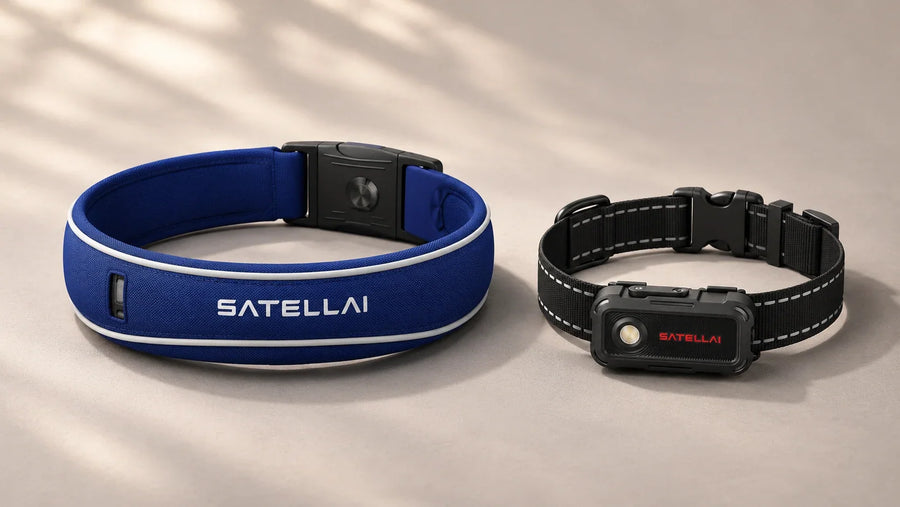
The category comparison above explains what the devices do. This model comparison answers a narrower question: which SATELLAI product matches that job? The official Collar Go comparison distinguishes its virtual-boundary alerts from the full Collar’s customizable fence feedback.
| Feature to check | SATELLAI Collar Go | SATELLAI Collar |
|---|---|---|
| Primary role | Tracking and escape awareness | Boundary management with tracking |
| Boundary function | Virtual-boundary exit alerts | Custom virtual fences with configured collar feedback |
| Device format | Tracker attached to compatible equipment | Integrated collar; check current neck sizing |
| Property assessment | An alert area does not make a space suitable for off-leash use | Use model-specific dog and property compatibility checks |
| Service | Review the current Go plan and feature access | Active telecom plan required, including for fencing |
| Before ordering | Check attachment, dog fit, regional service, and current operating-mode specifications | Check fit, usable area, training, charging, and current service terms |

For boundary management, review the SATELLAI GPS fence collar for fit, setup, and property conditions. For a tracking-first use case, start with the Collar Go product information. Compare current service terms for the chosen model; the Collar telecom plan is not automatically the plan for every SATELLAI device.
Five Questions Before You Buy
- What action do I need? Location, an app notification, collar feedback, or a combination?
- Where will it be used? Check likely travel routes or the entire proposed perimeter, not only the front porch.
- Does it fit my dog? Check current size, weight, attachment, and fitting instructions.
- Can I maintain it? Compare realistic charging, required service, testing, and support.
- What is the backup? Have secure identification, a physical way to control the dog, and a recovery plan.
For boundary learning, AVSAB recommends reward-based training and opposes aversive methods, including electronic shock collars. That guidance does not endorse static-feedback fencing. Seek qualified help if training causes fear or panic.
Frequently Asked Questions
Does “geofence” mean the collar will stop my dog?
No. A geofence is a defined geographic area used to detect an event. Product terms vary, so check whether crossing it causes an app alert, automatic collar feedback, or both. Neither outcome physically stops a dog.
Can one collar track my dog and provide fence feedback?
Yes, some systems combine those functions. Check their behavior separately, including training, minimum usable area, required service, and operation during a connection loss.
Can I use a tracker in an apartment?
A tracker can support outdoor walks, travel, and escape awareness, subject to fit and connectivity. Satellite positioning indoors or among tall buildings may be unreliable; do not treat a tiny mapped area as precise indoor containment.
Does a subscription determine whether it is a tracker or a fence?
No. Service billing and boundary behavior are different questions. Read the exact model’s plan terms and what each feature requires, rather than assigning capabilities from the presence or absence of a subscription.
What if I already have a secure physical fence?
A tracking-first device may provide backup location awareness if the dog escapes through an open gate or a damaged section. Repair and inspection still matter; the tracker does not maintain the fence.
Choose the Job, Then the Device
Choose tracking when you mainly need location and escape awareness. Consider boundary-focused features when you have a suitable recurring outdoor layout and can maintain the required training and checks. Make that distinction before comparing optional extras or maximum battery claims.
Sources and Editorial Information
- SATELLAI Collar product information
- SATELLAI Collar Go model comparison
- SATELLAI Collar service plans
- GPS.gov: positioning accuracy
- AVSAB: humane training position
About this guide: Published by SATELLAI, which sells products discussed here. Manufacturer information and linked guidance were reviewed on November 10, 2026. This article does not report independent comparative testing. Recheck the exact model, regional availability, and current terms before purchase.