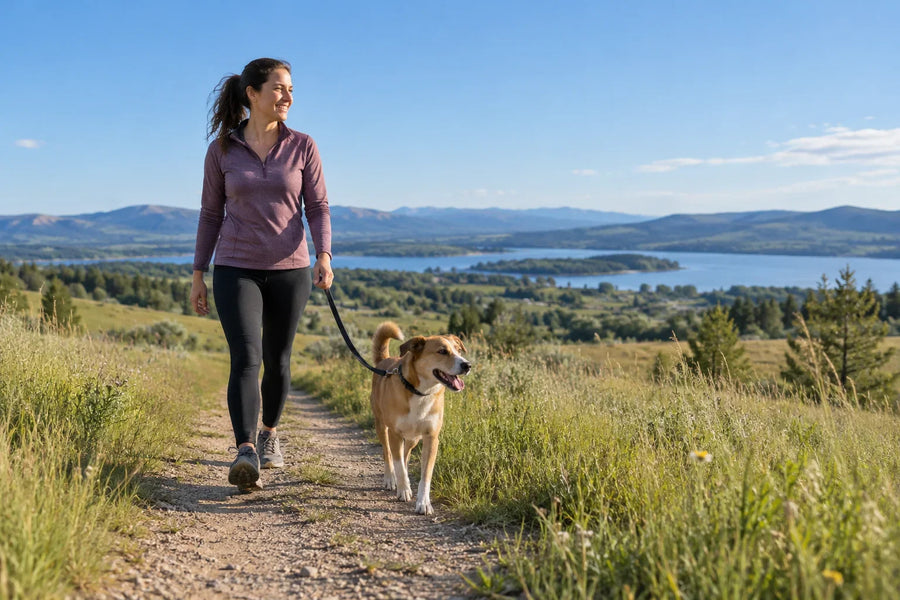
The best GPS dog fence for a large property should do more than advertise a high acreage limit. It should let you draw a practical boundary around the areas your dog can safely use, maintain reliable positioning across the property, provide clear boundary cues, and help you locate your dog if that boundary is crossed.
For acreage, farms, ranches, and oversized yards, GPS systems have one major advantage: they can create custom boundaries without trenching long runs of wire. But they are not physical barriers. Their performance still depends on property layout, satellite visibility, equipment condition, training, and responsible supervision.
30-Second Answer
- Choose a GPS dog fence designed for at least the size of your usable area—not simply the full acreage on the deed.
- Prioritize custom-shaped boundaries, no-go zones, dependable GPS positioning, on-collar cues, battery life, waterproofing, and live location tracking.
- Walk and test the planned perimeter before allowing off-leash use.
- Keep boundaries away from roads, water hazards, cliffs, neighboring livestock, and other areas where a delayed response could be dangerous.
- Use a physical fence or leash in high-risk locations. A virtual fence cannot physically stop a dog from crossing a line.
What Makes a GPS Dog Fence Suitable for Large Properties?
Large properties create a different buying decision from suburban yards. A system may cover many acres on paper yet still be a poor fit if it only creates circular boundaries, performs inconsistently near major obstructions, or cannot send useful alerts when a dog gets out.
The strongest options combine five capabilities:
- Enough usable coverage: The minimum and maximum fence sizes must fit the space you actually want the dog to use.
- Custom boundary shapes: You should be able to follow irregular property lines and exclude hazards within the larger safe area.
- Reliable location technology: Positioning needs to remain stable across open fields, slopes, tree lines, and the areas around buildings.
- Boundary support plus recovery tools: On-collar cues help with the trained boundary, while escape alerts and live tracking help if the dog leaves it.
- Outdoor durability: The collar needs appropriate water resistance, secure fit, dependable battery life, and a charging routine that works every day.
If you are still comparing coverage limits, start with our guide to how big a GPS dog fence can be.
Start With the Usable Area, Not the Total Acreage
A 40-acre property does not necessarily need a 40-acre dog boundary. The safest usable area may be a smaller section around the house, pasture, or work area.

Before choosing a system, mark:
- public roads and driveways;
- ponds, irrigation channels, wells, and steep terrain;
- livestock pens and poultry areas;
- neighboring properties;
- equipment yards, chemical storage, and workshops;
- dense woods, metal-roofed structures, and known cellular dead zones.
Then decide which spaces belong inside the main boundary and which should become no-go zones. This produces a more useful requirement than simply searching for the largest acreage claim.
The GPS Fence Features That Matter Most
Custom-Shaped Fences and No-Go Zones
Large rural properties are rarely perfect circles. A fixed circular boundary may include a road, pond, neighbor’s field, or livestock enclosure that should remain off-limits.
Look for an app that lets you draw irregular boundaries and create internal exclusion areas. Also check how many fences the system can store. Multiple saved locations can be useful for a home property, a family farm, a vacation property, or another place your dog visits regularly.
Positioning Performance and Boundary Buffers
GPS locations naturally fluctuate. A boundary placed directly beside a road, barn wall, tree line, or pond leaves little room for that variation.
Build a generous safety buffer inside the actual hazard. The correct distance depends on the system, terrain, signal conditions, and the speed at which your dog moves. Test the boundary by walking it repeatedly before relying on it as part of an off-leash routine.
Our guide to how a GPS dog fence works explains the relationship between satellite positioning, saved boundaries, collar feedback, cellular service, and phone alerts.
Signal Conditions Across the Property
Open sky generally gives a GPS collar the clearest view of navigation satellites. Dense tree canopy, tall buildings, deep terrain, and metal roofing may make positioning more difficult. These conditions do not automatically rule out GPS, but they make on-site testing essential. An official comparison from PetSafe similarly notes that property size and open-sky conditions should be considered when choosing between wired, wireless, and GPS systems: wired vs. wireless vs. GPS dog fences.

Walk the perimeter with the collar fully charged and the app connected. Test near barns, wooded edges, slopes, and every location where a wrong boundary reading would matter. If alerts appear inconsistent, adjust the fence farther from obstacles and review these steps for reducing virtual fence false alerts.
Feedback Options and Training
A GPS fence only becomes meaningful after the dog learns what its cues indicate. Training should introduce the boundary gradually, pair the warning with a clear return behavior, and reward the dog for moving back into the safe area.
Tone and vibration may be sufficient for some dogs. If optional static feedback is available in your market, it should never replace training, and settings must follow local rules and the dog’s individual needs. Dogs that panic, bolt through warnings, have hearing or sensory limitations, or show fear around the equipment may need a different containment plan developed with a qualified trainer.
Tracking, Alerts, and Connectivity
Boundary cues and recovery are related but different. Ask what continues working when cellular coverage is weak and which functions require a subscription or data plan.
A useful large-property system should clearly explain:
- whether the fence is stored on the collar;
- whether on-collar cues continue without a phone connection;
- whether live tracking requires cellular coverage;
- how quickly the owner receives an escape alert;
- how location history is displayed;
- whether each dog requires a separate collar or service plan.
Battery Life, Waterproofing, and Fit
A fence cannot help when the collar is charging on the kitchen counter. Choose a realistic charging routine and do not base it only on the maximum advertised battery figure. Tracking frequency, signal conditions, temperature, and feature use can affect real-world runtime.

The collar should also fit securely without restricting breathing or movement. Check it daily for rubbing, trapped moisture, mud, and damage—especially on dogs that work, swim, or move through brush.
When a GPS Fence Is—and Is Not—the Best Fit
A GPS fence is a strong fit when the usable area is large, reasonably open, and irregularly shaped. It is especially useful when burying wire across fields, driveways, or changing terrain would be costly or impractical.
It is not the best stand-alone choice when the digital boundary would sit directly beside a road, livestock enclosure, cliff, or another immediate hazard. In those locations, use a physical barrier or leash. Many acreage owners combine physical protection around high-risk edges with GPS boundary support and tracking across lower-risk open space.
See our GPS fence vs. traditional fence comparison for a fuller breakdown of the two approaches.
Is SATELLAI Collar a Good Fit for Large Properties?
The SATELLAI Collar is designed for GPS virtual fences starting at 0.5 acre and extending to very large custom areas. It supports custom-shaped virtual fences and no-go zones, real-time GPS tracking, and configurable boundary feedback. Current product specifications also list IP68 water resistance and up to three days of maximum battery life.
That combination makes it a strong candidate for large yards, farms, and ranches where owners want flexible boundaries without burying wire. The product’s fence settings are stored on the collar, while real-time tracking, boundary alerts sent to the phone, and app-based services require an active Telecom Plan and adequate connectivity.
SATELLAI Collar is not a physical fence, and it should not be presented as a guarantee that a dog cannot leave the property. Its best use is as one part of a safety system that includes property assessment, appropriate barriers, training, identification, supervision, and a practiced recovery plan.
How to Set Up a GPS Fence on a Large Property
- Map the hazards first. Mark roads, water, livestock, equipment, neighboring land, and difficult signal areas.
- Draw the boundary inside the safe area. Do not place the digital line directly on a dangerous edge.
- Create internal no-go zones. Exclude ponds, workshops, feed storage, gardens, or animal enclosures as needed.
- Walk-test the entire perimeter. Test at different times and around buildings, slopes, and tree cover.
- Introduce the cues on leash. Teach the dog to turn back and reward that decision consistently.
- Increase freedom gradually. Move from leash to long line before considering supervised off-leash time.
- Recheck the system routinely. Confirm battery, fit, app status, fence settings, and identification before use.

Final Verdict
The best GPS dog fence for a large property is not simply the one with the biggest coverage number. It is the system that fits the usable acreage, lets you design safe boundaries, performs reliably in the actual terrain, gives the dog understandable cues, and provides useful tracking if the boundary is crossed.
For open acreage and irregular property shapes, SATELLAI Collar offers a relevant combination of customizable virtual fencing and live location tools. Where a road, livestock area, or other immediate hazard is involved, keep a physical barrier or leash in the plan.
Frequently Asked Questions
Do GPS dog fences work on large properties?
They can work well on large, reasonably open properties when the system supports the required acreage and custom boundary shape. Performance should be tested across the actual terrain, especially near dense trees, metal-roofed buildings, slopes, and other obstructions.
What is the best dog fence for several acres?
It depends on the risk outside the boundary. GPS fencing is flexible for large or irregular areas, while physical fencing is usually the safer choice beside roads, livestock, cliffs, or other immediate hazards. Many properties use both.
Can a GPS fence work without cellular service?
GPS positioning and a boundary stored on the collar may continue without cellular service, depending on the product. Live tracking, phone notifications, and remote updates generally require connectivity. Confirm the behavior of the specific system before purchase.
Can I use a GPS fence in wooded areas?
Possibly, but dense canopy can make satellite positioning more challenging. Test the entire proposed boundary and leave wider buffers near hazardous edges. A system that works well in an open pasture may behave differently in dense woods.
Does a GPS dog fence replace a physical fence?
No. A GPS fence provides a digital boundary and trained cues, not a physical barrier. It cannot stop another animal from entering or physically prevent a determined or frightened dog from crossing the line.