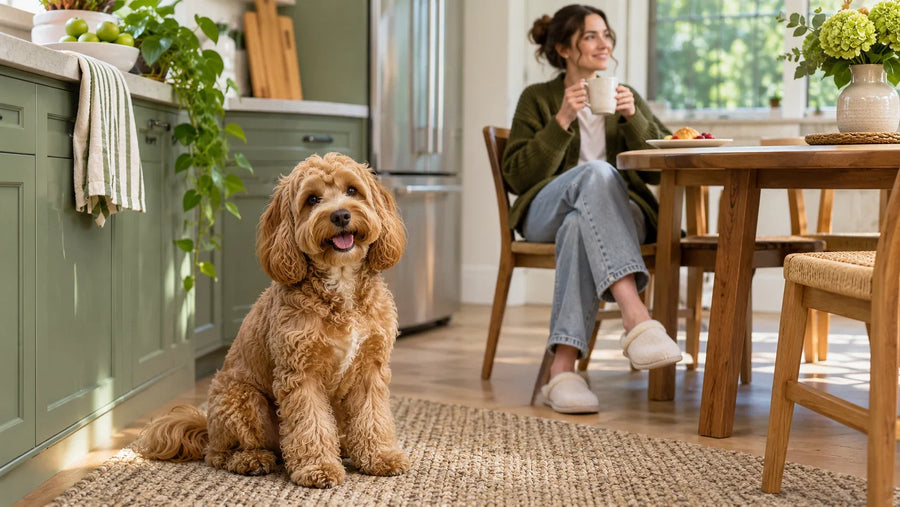
Choosing two dog names gives you twice the possibilities—and one extra question: will the pair work when you need to address just one dog?
A shared food, nature, or classic-name theme can make the pair feel connected. Before choosing, compare the actual sounds and likely nicknames: those are the versions you will use when both dogs are nearby.
Good names for two dogs share a connection while remaining distinct enough for your household to use consistently. Theme is optional; each dog's name should work on its own.
The pairs below provide themed starting points. Choose the names first, then teach each dog an individual response through practice.
Start With the Kind of Pair You Want
| Pair style | Example | Connection |
|---|---|---|
| Familiar human names | Henry and Mabel | A similar classic feel |
| Food theme | Biscuit and Olive | A shared category without identical sounds |
| Nature theme | Cedar and Brook | An outdoor association |
| Contrast | Moose and Pip | Different scales and rhythms |
| Playful title pair | Captain and Duchess | A coordinated introduction |
Say each name separately, then have another caregiver repeat it. If you have to ask which name they said, compare a more distinct pair before committing.
Classic Names for Two Dogs
These combinations share an overall style without requiring a joke or a story.
| Pair | Why it works as a theme |
|---|---|
| Henry and Mabel | Traditional given names |
| Cooper and Ruby | Familiar everyday choices |
| Walter and June | A quieter vintage feel |
| Archie and Pearl | Friendly with a classic touch |
| Finn and Daisy | Different lengths and rhythms |
| Theo and Bonnie | Warm, familiar options |
| Gus and Poppy | A brief name paired with two syllables |
| Oscar and Nell | A formal-feeling name and a short one |
| Louie and Hazel | A conversational pair |
| Charlie and Ruth | A casual name and a compact classic |
Use these combinations for any two dogs; a male/female pairing is not required. Assign the names according to your preference, and check that you enjoy each one when used alone.
For more candidates without sorting by boy or girl, browse our unisex dog names. Keep one name you like and compare a few possible partners.
Food-Inspired Pairs
A food theme offers a clear connection without requiring names that rhyme.
| Pair | Theme |
|---|---|
| Biscuit and Olive | A cozy kitchen pairing |
| Waffles and Fig | Breakfast and fruit |
| Pickles and Brie | Savory-food inspiration |
| Noodle and Toast | Everyday comfort foods |
| Mango and Pretzel | Sweet and salty associations |
| Mochi and Pepper | Different sounds within a food theme |
| Dumpling and Basil | A dish and an ingredient |
| Tater and Coconut | A playful pantry pair |
| Bagel and Peaches | Breakfast-table imagery |
| Ravioli and Ginger | A longer name paired with a familiar one |
Check the nicknames, too. Ravioli and Ginger may sound distinct, but if the household automatically shortens Ravioli, compare that actual version.
If you like Biscuit and Olive but want to replace one half of the pair, browse our cute dog names for alternatives such as Teddy, Mochi, or Poppy. Keep the name you like and compare the second one against it.
To build a different kitchen-themed pair, use our food-inspired dog names. Compare the likely short forms as well as the full names.

Nature-Inspired Pairs
| Pair | Theme |
|---|---|
| Cedar and Brook | Forest and water |
| Maple and Flint | Tree and stone |
| Willow and Comet | Botanical and celestial |
| Aspen and Reef | Mountain and coast |
| Fern and Summit | Forest detail and high landscape |
| Rain and Clover | Weather and greenery |
| Birch and Luna | Tree and moon association |
| Canyon and Skye | Land and sky |
| Moss and Aurora | Forest texture and sky imagery |
| Dune and Hazel | Landscape and plant |
Cedar and Brook share an outdoor theme while using different opening sounds. Moss and Aurora pair a short name with a longer one. Use the theme to connect the pair, then compare the sounds separately.
If one dog is already named River, keep it as the anchor and compare potential partners such as Fern or Atlas. Renaming the first dog is not necessary just to create a theme.
Playful and Contrasting Pairs
| Pair | Connection |
|---|---|
| Moose and Pip | Large and small imagery |
| Captain and Duchess | Title-style introductions |
| Professor and Scout | Study and exploration |
| Velvet and Rocket | Soft and energetic associations |
| Pixel and Banjo | A playful object pair |
| Pebble and Atlas | Small object and expansive-map association |
| Tux and Boots | Clothing-inspired names |
| Mabel and Gizmo | Familiar and inventive styles |
| Otis and Sprout | A given name and a plant image |
| Wren and Thunder | A small bird and a big sound |
Choose contrasts based on words or images rather than fixed behavioral labels. Moose and Pip gives you a size contrast; calling one dog “the bad one” adds no useful naming information.
Choose names you can use kindly for both dogs across different situations.
Test Each Name Separately
A coordinated pair still needs two individual identities. Make sure you enjoy each name when the other dog is not part of the conversation.
Use this simple check:
- Say each at a normal volume, without adding a cue.
- Ask another caregiver to repeat it.
- Compare the first sounds, vowel patterns, and usual nicknames.
- Check the names against cues used in your home.
- Try each in a sentence about a vet visit or pet-sitting arrangement.
Compare the versions you will actually say. A pair may look different on paper but become similar after shortening. Jasper and Casper share much of their sound; Jasper and June give you a clearer contrast in length and ending. Dogs still need practice with either pair.
Our guide to best dog names for training explores that issue in more detail.
Introduce the Names With Individual Practice
Practice each dog's name in a quiet setting with the other dog at a comfortable distance or occupied elsewhere. Reward the intended dog's attention. Once each responds in that easy setup, gradually practice with both present.
A name is not an automatic recall cue. Teach responding to the name and returning to you as separate skills.
Use reward-based teaching, consistent with the American Veterinary Society of Animal Behavior's guidance. If both dogs keep responding to either name, increase distance or return to separate practice. Do not create distress by isolating a dog who is uncomfortable with separation.
Keep records clear as well. Use the correct name on each dog's tag, veterinary information, medication instructions, and caregiver notes.
Need a new partner for a name you are keeping? Run the SATELLAI Dog Name Generator for the second dog, choose a compatible style, and compare three suggestions aloud with the existing name.

Frequently Asked Questions
Should two dogs have matching names?
Only if you like the idea. Unrelated names can work equally well. The theme is for people; each dog needs experience with their own name.
Are rhyming names a bad idea?
Not always, but they may be less convenient to distinguish when spoken quickly. Test the actual sounds and nicknames before choosing.
Can I keep one dog's name and choose a matching name for the other?
Yes. There is no need to rename a dog solely to create a coordinated pair.
What are good names for two female or two male dogs?
Any pairing can be adapted. Henry and Oscar, Mabel and Ruby, or Cedar and Brook offer different styles without requiring a male/female theme.
Should both dogs come when I say either name?
That depends on what you teach. Practice individual responses and, if useful, teach a separate shared cue. Do not assume name selection alone establishes either behavior.
Choose a theme you enjoy, keep each name usable on its own, and check the everyday sounds before deciding. Then teach the individual responses rather than expecting the matching theme to do that work.