Rebuilding trust with a fearful dog is not about making the dog accept touch as quickly as possible. It is about creating repeated experiences in which the dog feels safe, retains meaningful choices, and learns that people respond consistently to their communication.
Some dogs become more comfortable within days. Others need weeks or months before they voluntarily approach, rest nearby, accept handling, or explore unfamiliar places. Progress depends on health, temperament, early social experience, previous learning, the intensity of fear, and the dog's current environment.
Quick answer: Give a fearful dog time, distance, predictable care, and control over nonessential interaction. Turn your body slightly away, avoid reaching, reward voluntary approach, and stop when the dog asks for space. Trust grows through many manageable experiences, not one dramatic breakthrough.
What Trust Looks Like in a Fearful Dog
Trust does not always begin with cuddling or play. Early signs may be small:
- Eating while a person remains in the room
- Resting instead of watching every movement
- Choosing to remain nearby when an exit is available
- Approaching briefly and moving away without panic
- Taking food with a softer body posture
- Recovering more quickly after a household sound
- Exploring a room or yard at a comfortable pace
A dog can trust one person in one environment and still fear other people, places, or types of handling. Trust is contextual, not an all-or-nothing personality trait.
Begin With Health and Safety
Pain and illness can contribute to fear, avoidance, touch sensitivity, irritability, and aggression. Arrange a veterinary examination when fear is new, unexplained, worsening, or accompanied by appetite, sleep, mobility, digestive, skin, hearing, or vision changes.
At home, prevent avoidable scares and escapes. Check doors, gates, windows, leashes, harness fit, identification tags, and microchip information. A frightened dog may bolt through an opening that a relaxed dog would ignore.
Tracking technology can provide an additional recovery layer if a dog escapes, but it cannot replace a leash, secure barrier, supervision, or gradual training.
Lower Social Pressure
Humans often try to reassure a scared dog by facing the dog, leaning forward, reaching over the head, speaking continuously, or moving closer. Those actions may feel intense to a dog that is already uncertain.
Instead:
- Turn your body slightly sideways
- Keep movements slow and easy to predict
- Avoid prolonged direct staring
- Keep hands close to your body
- Allow the dog to approach and retreat
- Sit at a distance rather than following the dog
- Use a calm voice without repeatedly calling
Your goal is not to make yourself interesting enough that the dog must approach. It is to become safe enough that approaching becomes an available choice.
Create a Predictable Daily Rhythm
Predictability reduces the number of surprises a fearful dog must process. Keep meals, bathroom breaks, rest, walks, and quiet interaction within a recognizable daily pattern.
Announce necessary actions with consistent cues. A short phrase before opening a door, attaching a leash, placing a food bowl, or beginning care can help the dog predict what follows.
Predictability should not become rigid. Once the dog is more comfortable, introduce small variations gradually so an unavoidable schedule change does not feel overwhelming.
Provide a Protected Resting Area
A fearful dog needs somewhere to rest without being followed. The area should be comfortable, away from heavy foot traffic, and accessible without passing through social pressure.
When the dog retreats there, household members should not reach in, pull the dog out, or use food to lure the dog into contact. Children and visitors must treat the area as off-limits.
See our guide to creating a safe space for your dog for setup and introduction steps.
Let Food Support Choice, Not Override It
Food can build positive associations, but it can also create conflict if a hungry dog moves closer than feels safe.
Instead of holding food beside your body, gently place or toss it where the dog can eat without approaching. Over time, food can be placed at a range that allows voluntary movement while preserving an easy retreat.

Watch the whole dog. Reaching for food while leaning backward, stretching the neck, crouching, or immediately fleeing does not necessarily mean the dog is comfortable with the distance.
If the dog will not eat, increase distance or reduce the difficulty. Do not withhold normal meals to make the dog more willing to approach.
Reward Voluntary Check-Ins
A check-in may be a glance, a small step toward you, a relaxed sniff, or choosing to remain in the same room. Quietly reinforce these behaviors with food, access to something enjoyable, soft praise, or simply continued space.
Avoid immediately reaching for the dog after an approach. Otherwise, approaching may predict the exact pressure the dog was trying to evaluate.
Short interactions often build more trust than long sessions. End while the dog is still comfortable.
Ask for Consent Before Touching
When a dog begins approaching, do not assume that proximity equals permission to pet.
If touch is safe, begin briefly on an area many dogs find less threatening, such as the chest or shoulder, rather than reaching over the head. Pause after one or two seconds.
If the dog leans in, stays loose, or reinitiates contact, you may continue briefly. Stop if the dog turns away, stiffens, lowers, steps back, licks the lips repeatedly, closes the mouth, or stops choosing contact.
A consent check is not a perfect test, especially when a dog has learned to freeze. Read the full body and keep the interaction easy to end.
Use Reward-Based Training to Create Communication
Training can give a fearful dog predictable ways to influence what happens. Start with simple behaviors that do not require close handling:
- Looking toward you
- Touching a target with the nose
- Following a tossed treat
- Stepping onto a mat
- Moving through an open doorway
- Choosing to approach a leash or harness
Keep sessions short and reinforce effort. Avoid leash corrections, intimidation, forced positioning, or punishing warning signals. The American Veterinary Society of Animal Behavior recommends reward-based methods for training and behavior modification.
Introduce New Experiences Below the Fear Threshold
Once daily life is stable, new people, places, sounds, and care activities can be introduced gradually.
Below threshold, the dog can notice the situation and still eat, explore, disengage, or respond to familiar cues. Above threshold, the dog may freeze, flee, bark, lunge, shut down, or refuse food.
Work at a greater distance, shorter duration, or lower intensity than the point that produces distress. One calm minute can be more useful than twenty minutes of barely tolerated exposure.
Do not measure progress only by physical proximity. Softer posture, voluntary exploration, faster recovery, and renewed interest in the environment are equally important.
Manage Visitors Carefully
Tell visitors not to reach, stare, call, corner, or offer a hand for the dog to sniff. That familiar greeting advice can still place a hand directly into the dog's space.
Begin with the dog behind a gate, at a comfortable distance, or in a protected room. The visitor can sit sideways and ignore the dog. If the dog chooses to investigate, the visitor should remain calm and avoid turning the approach into a touching session.
Not every dog needs to greet every visitor. Comfortable separation is a valid outcome.
Build Confidence Outside the Home
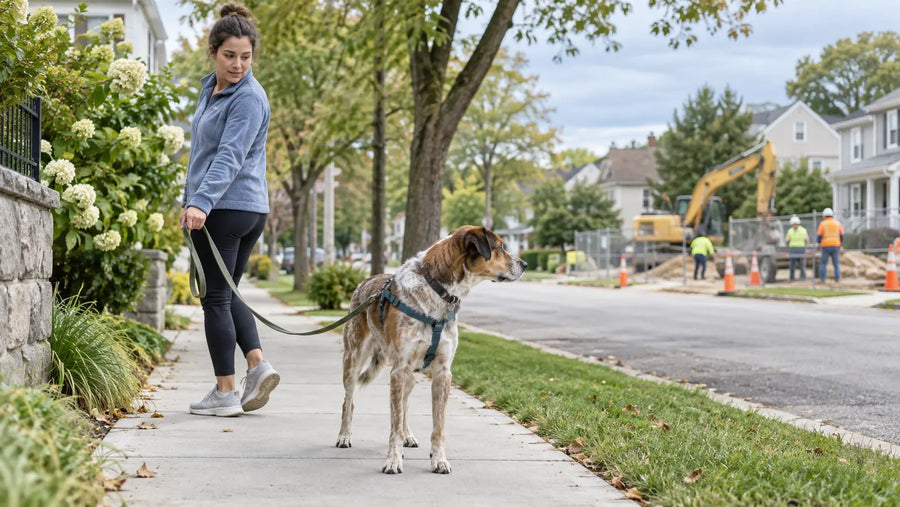
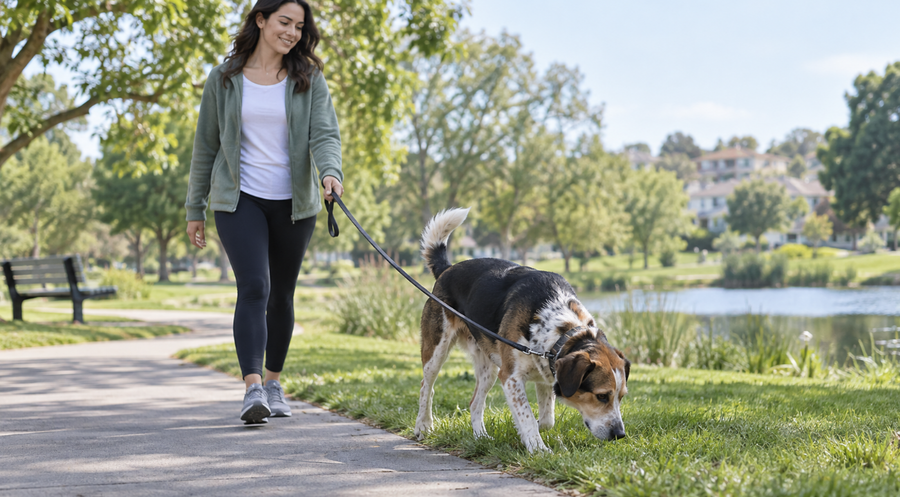
Start in the quietest practical environment. Allow sniffing, use a comfortable loose leash, and keep outings short enough for the dog to recover.
Choose distance over confrontation when people, dogs, vehicles, or construction appear. Crossing the street or turning around does not reward fear; it prevents the situation from becoming overwhelming.

As confidence grows, vary routes and environments gradually. A calm neighborhood walk may be a better foundation than a crowded market or dog park.
Expect Setbacks
Progress is rarely linear. A dog may struggle after poor sleep, illness, a frightening event, a noisy day, a schedule change, or several difficult experiences close together.
When a setback occurs:
- Reduce demands and restore safety.
- Check for possible pain or illness.
- Return to an easier distance or step.
- Allow additional rest and recovery.
- Review what changed before the behavior.
A setback does not erase previous learning. It provides information about the dog's current capacity.
Common Trust-Building Mistakes
- Forcing affection: Holding, hugging, or cornering may teach the dog that people ignore attempts to leave.
- Moving too quickly: One successful interaction does not mean the dog is ready for greater pressure.
- Luring into discomfort: Food should support safe choices, not pull the dog into a trap.
- Punishing growling: A growl communicates a need for distance. Suppressing it does not resolve fear.
- Giving inconsistent rules: Different household responses make people harder to predict.
- Assuming shutdown means calm: Stillness, refusal to move, or lack of response may reflect intense fear.
- Ignoring physical health: Pain can limit tolerance and change behavior.
How Long Does It Take to Gain a Fearful Dog's Trust?
There is no reliable universal timeline. Mild uncertainty in a stable home may improve quickly. Long-standing fear, limited early socialization, repeated trauma, pain, or multiple triggers may require much more time.
Track functional changes instead of waiting for a perfect transformation:
- Can the dog eat and rest more comfortably?
- Is the dog exploring more?
- Are approaches becoming voluntary?
- Can the dog move away without panic?
- Does recovery happen more quickly?
- Can essential care occur with less distress?
Our guide to how dogs show love and trust explains why relaxed everyday choices are often more meaningful than dramatic displays of affection.
When to Get Professional Help
Contact a veterinarian when fear begins suddenly, worsens, or occurs with pain, appetite loss, sleep disruption, mobility changes, digestive symptoms, skin irritation, confusion, or sensory decline.
Seek a veterinary behaviorist or qualified reward-based professional when the dog:
- Cannot eat, rest, or recover around ordinary household activity
- Panics during brief absences or confinement
- Attempts dangerous escapes
- Shows aggression that creates an immediate safety concern
- Cannot tolerate necessary veterinary or grooming care
- Continues worsening despite careful management
Medication may be part of an appropriate treatment plan for some dogs. Only a veterinarian should recommend and monitor it.
Frequently Asked Questions
How do I get a scared dog to trust me?
Reduce pressure, keep routines predictable, sit at a comfortable distance, reward voluntary interest, and let the dog end nonessential interactions. Trust develops through repeated safe experiences.
Should I ignore a fearful dog?
You do not need to ignore the dog completely. Provide calm care and respond to communication, but avoid staring, reaching, following, or demanding contact.
Should I hand-feed a fearful dog?
Not initially if approaching your hand creates conflict. Place or toss food at a comfortable distance. Hand-feeding can be introduced only when the dog's body language remains relaxed and approach is voluntary.
Can I comfort a dog when it is afraid?
Yes, if the dog seeks contact and remains comfortable. Calm support does not reinforce fear, but forced holding, crowding, or blocking escape can increase distress.
How long will it take a rescue dog to trust me?
Timelines vary from days to months or longer. Measure changes in rest, exploration, recovery, and voluntary interaction rather than expecting affection by a fixed deadline.
The Bottom Line
Trust is built when a fearful dog learns that people are predictable, communication works, and moving away remains possible. Begin with safety and health, lower social pressure, and reward voluntary engagement.
Move at the dog's pace without abandoning necessary safety management. Small changes—resting nearby, exploring, recovering faster, or choosing one brief approach—can represent meaningful progress.
Sources
- American Veterinary Society of Animal Behavior: Position Statements
- Merck Veterinary Manual: Behavior Problems of Dogs
- RSPCA: Understanding Your Dog's Behavior