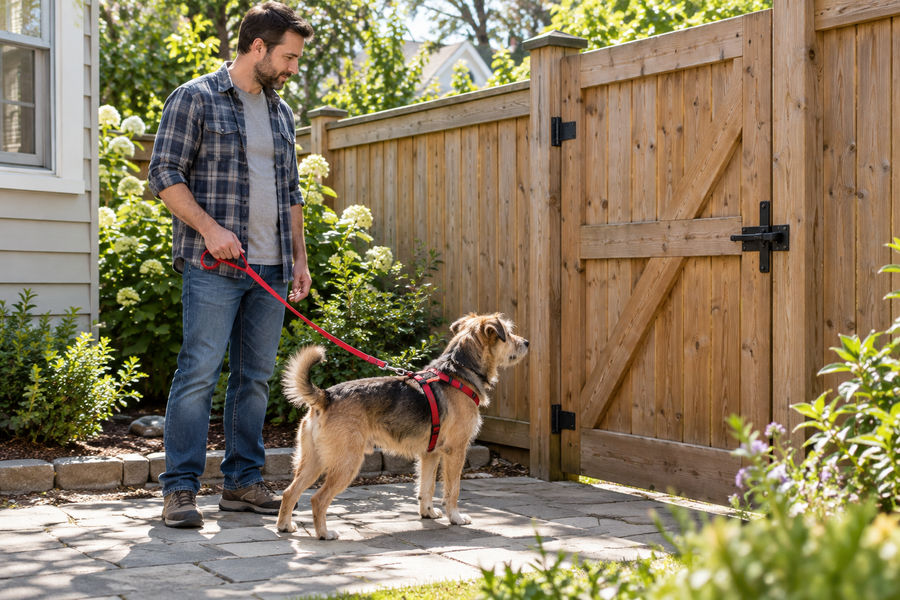
In a small backyard, every gate, gap, and corner matters. The driveway may be just outside the fence, and a patio or shed can take up much of the space you want your dog to use. The best dog fence for a small backyard fits the layout and your dog's habits, whether they tend to dig, climb, squeeze through gaps, or rush the gate.
Quick answer: For most small backyards, start with a physical fence and secure gate. Choose solid panels when you want to block the view outside, an open fence with suitable spacing when you want to keep the view, or repairs when an existing fence has only a few weak spots. A secured pen can suit a smaller supervised area; a long line is a temporary handling option rather than a fence.
About our recommendations: SATELLAI publishes this guide. We compare fence types by usable space, escape behavior, gate design, maintenance, and supervision needs, using the sources linked below. These are planning recommendations, not contractor quotes or tests of fence manufacturers.
Best Small-Backyard Fence Options at a Glance
| Option | Best fit | Main limitation |
|---|---|---|
| Solid privacy fence | Yards where visibility through the perimeter is a concern | Height, base gaps, and maintenance still matter |
| Appropriately spaced metal fencing | Owners who want an open view | Small dogs may fit through gaps; climbing must be assessed |
| Existing fence with targeted repairs | A generally sound yard with specific weak points | Repairs must address the dog's actual escape route |
| Secured outdoor pen or dog run | A defined supervised area within the yard | Not every pen can contain every dog |
| Supervised long line (temporary handling) | Outdoor time while a permanent solution is arranged | Not a fence; requires active handling and space free of entanglement hazards |
| GPS boundary system | Sites that meet the specific system's requirements | No physical barrier; supported area and clearance matter |
Start With the Usable Yard, Not the Lot Size
Sketch the part of the yard your dog will use and mark gates, driveway access, steps, sheds, and any hazardous features. Include objects near the perimeter that might become footholds, such as storage boxes or patio furniture. A smaller, well-planned enclosure can be more practical than fencing every available corner. Describe how your dog behaves outside before choosing the design. A dog that squeezes through gaps needs different details from one that climbs, digs, or rushes an open gate. There is no universal fence height that guarantees containment for every dog, so ask the installer to assess the behavior as well as the measurements.
1. Best for Limiting the View Outside: A Privacy Fence
A solid fence may be useful when your dog fixates on activity beyond the yard. It reduces the view through the perimeter, although your dog may still hear or smell what is on the other side. Choose the design around the dog's behavior rather than assuming that a privacy panel will eliminate barking or escape attempts. Check gate construction and ground clearance along with the panels. A high fence can still have a gap under the gate, and patio furniture can create a route over it. Inspect the barrier from your dog's side so you can identify footholds and openings that are easy to miss from outside.
2. Best for an Open View: Suitable Metal Fencing
Open metal fencing can preserve visibility across a compact yard. The important questions are whether your dog can fit through the spacing, push through weak areas, or use the structure to climb. A tidy-looking fence is not enough if your dog can squeeze through it. The American Kennel Club's fence overview notes that some dogs can climb chain link, while small dogs may squeeze through widely spaced bars. Ask the installer to assess spacing, climbability, and the fence base for your dog. An open design also leaves activity beyond the yard visible.
3. Best Use of an Existing Fence: Fix the Weak Point
If most of your fence is sound, a targeted repair may be more useful than replacing the entire perimeter. Check latches, loose panels, gaps under gates, and areas where the ground has changed. A dog that digs under one corner needs that route assessed before you spend money on a different tracking device. Bring photographs and measurements to a qualified installer when the repair involves structure or the ground beneath the fence. Ask how the proposed work addresses your dog's specific route out. Review the whole perimeter afterward, since closing one gap does not establish that the remaining boundary is secure.

4. Best for a Smaller Enclosed Area: A Secured Pen or Run
A pen or dog run can create a smaller outdoor area while leaving part of the backyard open. Choose an outdoor-rated design suitable for your dog's size and behavior, and follow the manufacturer's installation guidance. Loose lightweight panels may be unsuitable for a dog that pushes, climbs, or jumps. Check access to shade and water, the walking surface, and how the gate works. Keep watching your dog while assessing a new enclosure. A portable pen is not automatically appropriate for unsupervised use simply because it stands upright when empty.

5. Best Temporary Alternative: Supervised Long-Line Time
If you cannot install a barrier immediately, a long line may allow supervised outdoor time with more room than a short walking leash. Use suitable, well-fitted equipment and keep the line under active control. Clear the area of obstacles that could catch the line, and avoid arrangements that allow the dog to reach the road or neighboring property. A long line is not a permanent fence and should not become unattended tethering. Match the available length to the usable yard rather than buying the longest option. Where the space is too tight to manage safely, ordinary leashed outdoor time is a simpler temporary choice.
Are GPS Fences a Good Choice for Small Backyards?
Measure the usable boundary area before considering a GPS fence. A compact yard may not leave room for the manufacturer's required area, boundary layout, or clearance from hazards. Satellite positioning can also be affected by nearby structures, as explained in GPS.gov's accuracy guidance.
The SATELLAI model comparison specifies a planned virtual-fence area of at least 0.5 acre for SATELLAI Collar. That is 21,780 square feet. A 40-by-60-foot backyard, for example, covers 2,400 square feet—well below that requirement. Use the area you actually intend to fence, not the acreage of the entire lot.
SATELLAI Collar Go can add tracking and boundary alerts sent to your phone for a compatible dog, but those functions do not form a fence. Collar Go's alert boundaries serve a different purpose from SATELLAI Collar's fence functions and do not share the same stated area requirement. Choose the physical fence first, then consider tracking as a backup if your dog gets loose.
What About Buried-Wire Fences?
A buried-wire system and a GPS system define boundaries differently. The former uses an installed wire to mark the boundary; the latter relies on positioning, so their site requirements are not interchangeable. Both still lack the physical separation provided by a built fence. For a compact yard near traffic or neighboring animals, weigh that lack of a barrier before comparing installation convenience. Check the specific product's dog compatibility and training method as well as its layout requirements. A secure physical enclosure may better match the reason you want a fence in the first place.
How to Compare Quotes and Choose a Layout
When you request estimates, give each installer the same measurements and explain how your dog behaves outside. Ask whether the quote includes gate hardware, ground-level gaps, removal of the old fence, and any necessary repairs to the supporting structure. Comparing the same scope helps you see why two prices differ. Check property boundaries and any requirements from your landlord, homeowners association (HOA), or local government before installation. These conditions vary, so obtain the rules that apply to your address rather than relying on a generic height recommendation. Point out nearby pools, driveways, and other hazards when you discuss the layout.
Finally, plan how the yard will be used. A secure fence works best with a clear gate routine, supervision appropriate to your dog, and training that rewards the behavior you want. AVSAB's humane-training position supports reward-based methods; a new barrier should complement those routines.
Our Recommendation
Keep and repair an existing physical fence if it can be made suitable for your dog. For a new enclosure, choose privacy or open fencing around the dog's behavior and the yard's layout, giving gate hardware and ground-level gaps the same attention as the panels. Use a secured pen for an appropriate smaller area or leashed supervision while arranging permanent work. Consider GPS tracking after those perimeter decisions are settled.
Frequently Asked Questions
What is the best fence for a small dog in a small backyard?
Choose a physical barrier with openings the dog cannot pass through, a secure gate, and a design appropriate to their jumping or climbing behavior. Dog size alone does not determine the right height or material. Inspect ground clearance as carefully as panel spacing.
Can I use a GPS fence in a very small yard?
Only consider a system whose documented site requirements your yard meets. Check usable area and clearance from hazards, not just total property size. SATELLAI Collar's comparison page specifies a planned fence area of at least 0.5 acre.
Is a privacy fence always better than chain link?
No. Privacy panels reduce visibility through the boundary, while an open design preserves the view. Fit the choice to your dog's escape behavior, the required structure, and maintenance needs rather than treating one material as universally best.
Can a GPS tracker replace a backyard fence?
No. A tracker provides location support if your dog leaves. A fence creates a physical barrier, subject to suitable construction and maintenance. For a small backyard, solve the perimeter and gate needs first, then consider tracking as an additional layer.