Hunting dogs are bred and trained to work through scent, distance, water, dense cover, and changing terrain. Those abilities make them capable partners in the field, but they do not make them immune to getting lost, injured, overheated, or distracted by wildlife.
The safest approach uses several layers of protection: reliable field control, gradual conditioning, pre-hunt scouting, visible identification, appropriate tracking equipment, regular water and rest, active supervision, and a complete post-hunt check.
No single collar, camera, vest, or command can guarantee a dog's safety. Every outing should also follow local hunting, firearm, access, leash, wildlife, and trail-camera regulations.
Quick Answer: How Do You Keep a Hunting Dog Safe?
To protect a hunting dog, prepare before the season rather than waiting until opening day. Teach a reliable recall and emergency stop, build fitness gradually, check weather and terrain, scout unfamiliar ground, and pack water, identification, high-visibility gear, first-aid supplies, and a suitable tracking system. During the hunt, monitor the dog's location, movement, breathing, behavior, and recovery. Afterward, inspect the eyes, ears, paws, skin, and coat for injuries, ticks, burrs, and grass seeds.
A tracking device can help you locate a dog, but it does not replace recall training or direct supervision.
1. Build Reliable Field Control Before the First Hunt
A dependable recall is one of the most important hunting dog safety skills. Begin indoors or in a securely enclosed area with very few distractions. Say the dog's name, use one consistent recall cue, and reward the dog immediately for turning toward you and returning.

Use a reward that matters to that individual dog, such as food, a favorite retrieve, or a brief game. Once the response is consistent, gradually increase the distance and introduce controlled distractions. A long line attached to a well-fitted harness can provide an extra layer of control during the transition to larger outdoor spaces.
Field control should include more than “come.” Depending on the dog's role, useful foundation cues may include:
- Stop or sit at a distance: Interrupts movement before the dog reaches a road, unsafe water, livestock, or another hunting party.
- Stay or place: Keeps the dog in a known position while the handler assesses a situation.
- Heel: Provides close control around vehicles, parking areas, gates, and other people.
- Leave it: Helps disengage the dog from unsafe objects, carcasses, bait, or other hazards.
- A trained whistle cue: Carries farther and sounds more consistent than a stressed or tired human voice.
Do not repeat a cue until it becomes background noise, and never punish a dog after it finally returns. Returning to the handler should remain safe and rewarding. The American Kennel Club recommends developing recall in low-distraction settings before progressively adding distance and distractions. See its reliable recall training guidance.
Even well-trained dogs can react unexpectedly once prey drive takes over. If control is not dependable in a particular environment, use a long line or return to a safer training setup instead of testing the dog in an open hunting area.
2. Condition Your Dog for the Work Ahead
A dog that is active at home may still be unprepared for hours of uneven ground, cold water, thick vegetation, repeated retrieves, or warm-weather exertion. Increase distance, duration, and terrain difficulty gradually in the weeks before the season.
Schedule a veterinary check when appropriate, especially for a young dog entering its first season, a senior dog, or a dog with a previous injury or medical condition. Ask about region-specific vaccination, parasite, tick, and wildlife-disease risks. Do not give human pain medication or start supplements without veterinary guidance.
Condition the dog to its equipment before the hunt. Let it wear a vest, tracking collar, protective boots, or flotation gear during short controlled sessions. Check for rubbing around the neck, shoulders, armpits, chest, and paws. Equipment that looks correct while the dog is standing can shift or chafe once the dog runs, swims, and pushes through cover.
Fitness should be built progressively; opening day should not be the dog's first demanding workout of the season.
3. Scout the Hunting Area Before Bringing Your Dog
Before entering unfamiliar ground, review the property boundaries, access points, vehicle routes, roads, fences, water, steep areas, weather forecast, sunrise and sunset times, and expected cellular coverage. Identify where you could safely leave the area if the dog or a person is injured.

Recent footage from a trail camera can add useful context about wildlife movement around monitored locations before you bring a dog into the area. It may help you recognize frequently used paths, busy periods, or the presence of animals you did not expect.
However, a camera only shows what passed through its detection zone. It cannot reveal every animal, person, fence, unstable surface, toxic plant, trap, or weather-related hazard across the property. Combine footage with maps, landowner information, current weather, local reports, and an in-person assessment whenever possible. Confirm local rules before placing or using a trail camera, because regulations can vary by jurisdiction, land type, species, and season.
Your pre-hunt check should answer five questions:
- Where are the hard boundaries and nearby roads?
- Where are the safest entry, rest, water, and exit points?
- What terrain or wildlife hazards may affect the dog?
- Where does phone or tracking-device communication become unreliable?
- Who should be contacted if the dog becomes lost or injured?
4. Use Layered Hunting Dog Safety Gear
Safety gear should address different failure points. Identification helps someone return a found dog. Visibility helps people see the dog. Tracking helps the handler locate it. Water, first aid, and protective equipment address physical risks.
| Equipment | Primary role | Important limitation |
|---|---|---|
| Blaze-orange or high-visibility vest | Makes the dog easier to distinguish in vegetation and around other hunters | Must fit correctly and should not restrict movement or snag easily |
| Updated ID tag | Gives a finder a direct way to contact the owner | Can be lost or damaged; keep microchip registration current as a backup |
| GPS dog collar or tracker | Provides current or last-known location information | Communication method, battery, terrain, and network coverage affect performance |
| Trained whistle | Provides a consistent cue over distance and background noise | Has no meaning until the dog is conditioned to respond |
| Clean water and collapsible bowl | Supports hydration during work and rest | Natural water sources may contain pathogens, runoff, or harmful algae |
| Canine first-aid kit | Supports immediate care and safer transport | Does not replace veterinary treatment |
| Paw or body protection | Reduces exposure to sharp vegetation, ice, and rough surfaces | Poorly fitted gear can rub, trap debris, or interfere with movement |
| Buoyant, visible vest | Adds flotation and visibility during water work | Does not make cold water, current, ice, or exhaustion safe |
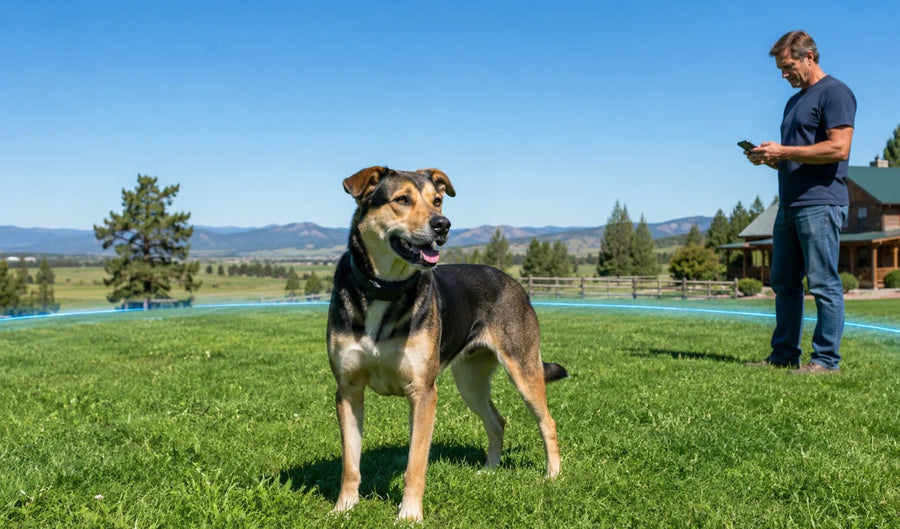
Where adequate cellular coverage is available, a GPS dog collar can add location awareness when a dog moves beyond visual range. Charge it fully, update the app and firmware, confirm that emergency contacts are correct, and test the device at the actual site before relying on it.
GPS positioning and live communication are not the same thing. Many smartphone-based collars use a cellular network to send the dog's calculated location to the handler. In weak or absent coverage, live updates can become delayed or unavailable. Review how dog GPS trackers work without cell service before choosing equipment for remote ground.
The AKC also recommends carrying first-aid supplies during a hunt and describes flotation gear for waterfowl dogs in its hunting dog training and safety advice.
5. Protect Your Dog During the Hunt
Before releasing the dog, confirm that every person in the party understands the plan, the dog's role, the working area, and the signals used by the handler. In any area where firearms are present, the handler should maintain awareness of the dog and other people at all times and follow all applicable firearm-safety requirements.
During the hunt:
- Check the dog's location regularly instead of waiting until it has been out of sight for too long.
- Offer rest and clean water before the dog appears exhausted.
- Adjust the workload for temperature, humidity, sun, wind, water temperature, terrain, age, fitness, and coat.
- Watch for changes in pace, responsiveness, breathing, coordination, posture, and willingness to continue.
- Inspect the paws and equipment contact points during longer breaks.
- Stop if conditions become less safe than expected, even if that means ending the hunt early.
Heavy panting that does not begin to settle with rest, weakness, vomiting, confusion, loss of coordination, collapse, breathing difficulty, or abnormal gum color can indicate an emergency. Stop exercise, move the dog to an appropriate safer environment, begin first aid within your training, and contact a veterinarian promptly.
Cold conditions require equal respect. Wet fur, wind, ice, exhaustion, and repeated cold-water entries can lower a dog's body temperature. Dry the dog, provide an insulated rest area, and watch for persistent shivering, weakness, slowed responses, or poor coordination.
6. Adjust Protection to the Terrain and Type of Hunt
Different environments create different safety problems. A single equipment checklist should be adapted to the hunt rather than followed mechanically.
| Environment | Common risks | Practical precautions |
|---|---|---|
| Upland fields | Wire, grass awns, thorns, poor visibility, hot exposed ground | Use high-visibility gear and inspect eyes, ears, coat, and paws frequently |
| Dense woods | Separation, fallen timber, ticks, low visibility, limited GPS or cellular communication | Strengthen recall, test tracking, shorten check-in intervals, and carry offline navigation |
| Waterfowl areas | Cold water, current, ice, submerged debris, exhaustion | Use suitable flotation and visibility gear, control entry frequency, and provide dry warm rest |
| Warm or humid terrain | Heat illness, dehydration, snakes, reduced recovery | Work during cooler periods, reduce intensity, carry extra clean water, and stop early |
| Farms and ranches | Livestock, machinery, vehicles, wire fencing, chemicals | Coordinate with the landowner and keep the dog away from active work areas |
| Remote backcountry | Long evacuation time, limited communication, changing weather | Share a route plan, carry offline maps, and choose communication equipment suited to the area |
Avoid assuming that a good performance on open ground will transfer immediately to woods, marsh, deep snow, or water. Introduce new environments progressively and maintain a larger safety margin while the dog learns.

7. Know What to Do if Your Hunting Dog Goes Missing
If the dog disappears, act quickly but do not create a second emergency. Stop, record the last confirmed location and time, and note the direction in which the dog was moving. Check the tracking app or receiver for current and last-known information.
Then:
- Alert everyone in the party and assign clear search areas rather than allowing people to scatter without coordination.
- Keep one familiar person near the last-seen point when safe; some dogs circle back.
- Check nearby roads, access points, water crossings, vehicles, and locations carrying familiar scent.
- Notify the landowner, property manager, ranger, or other appropriate authority.
- Contact nearby veterinarians, animal-control agencies, shelters, and relevant hunting groups if the search continues.
- Preserve accurate information about sightings and update searchers when new evidence appears.
Do not chase a frightened dog directly if doing so causes it to keep moving away. Use a calm familiar voice, familiar equipment, food, or another strategy appropriate to that dog's behavior.
For a more detailed recovery process, read what to do if a dog becomes lost in remote terrain.
8. Perform a Complete Post-Hunt Check
Adrenaline and drive can cause a working dog to continue despite an injury. Conduct a hands-on check before leaving the area and repeat it after the dog has rested.
Inspect:
- Eyes, eyelids, nose, mouth, and ears
- Neck and every place touched by a collar, harness, or vest
- Armpits, chest, abdomen, groin, and tail
- Legs, paw pads, spaces between the toes, and nails
- Coat and skin for ticks, burrs, grass seeds, cuts, punctures, swelling, and tenderness
- Movement for limping, stiffness, reluctance to jump, or uneven weight bearing
- Breathing, appetite, thirst, urination, behavior, and energy during recovery
The American Veterinary Medical Association advises checking pets for ticks during high-risk seasons. Review its tick and Lyme disease guidance, and ask your veterinarian about risks in the region where you hunt.
Seek veterinary care promptly for persistent bleeding, breathing difficulty, collapse, weakness, disorientation, eye injury, severe pain, suspected snakebite, deep puncture wounds, inability to walk normally, or any rapid deterioration. If something seems wrong after a demanding outing, do not assume the dog simply needs to “sleep it off.”
Hunting Dog Safety Checklist
Before the Hunt
- Confirm that training and fitness match the planned work.
- Review veterinary, vaccination, tick, and parasite needs.
- Check weather, access, terrain, water, roads, and legal boundaries.
- Review trail-camera information where its use is legal and relevant.
- Update identification and emergency contacts.
- Charge and test tracking and communication equipment at the site.
- Pack water, food if needed, first aid, visibility gear, dry towels, and an evacuation plan.
During the Hunt
- Maintain regular contact and location awareness.
- Offer rest and water before visible exhaustion.
- Monitor breathing, movement, behavior, temperature, and recovery.
- Check equipment fit and paws during breaks.
- Stop when conditions or the dog's condition reduce the safety margin.
After the Hunt
- Inspect the dog from nose to tail.
- Remove ticks, burrs, and debris safely.
- Recheck paws, eyes, ears, and equipment contact points.
- Monitor recovery and seek veterinary care when warning signs appear.
- Clean, recharge, and inspect all equipment before the next outing.
Frequently Asked Questions
Should a hunting dog wear a GPS collar?
A GPS collar can provide an additional layer of location awareness, particularly when a dog works beyond visual range. It should not replace recall training, identification, supervision, or compliance with leash and hunting rules. Check the device's communication method and test its battery and coverage in the area where it will be used.
How do you train a hunting dog to come back?
Begin with one consistent recall cue in a low-distraction, enclosed environment. Reward every successful return, then gradually increase distance and introduce controlled outdoor distractions. Use a long line during progression, and never punish the dog for returning. A qualified trainer experienced with sporting or working dogs can help tailor the process.
What should be in a hunting dog first-aid kit?
A basic kit may include gloves, gauze, bandaging materials, sterile saline or wound-rinsing supplies, blunt-tip scissors, tweezers or a tick-removal tool, a towel, emergency contact information, and any veterinarian-prescribed medication for that specific dog. Ask a veterinarian to review the kit and take a canine first-aid course before the season.
Should you use a trail camera before hunting with a dog?
Where legally permitted, trail-camera footage can add information about wildlife activity at monitored locations. It does not show the entire property or guarantee that conditions will be the same when the dog enters. Use it alongside maps, weather, landowner information, regulations, and an on-site safety assessment.
How often should a hunting dog rest and drink?
There is no safe universal interval. Water and rest needs change with the dog's size, fitness, age, health, coat, workload, temperature, humidity, wind, terrain, and water exposure. Offer regular opportunities before the dog looks exhausted, increase their frequency as conditions become harder, and stop if recovery is not prompt.

Final Takeaway
Hunting dog safety is a system, not a single product. Training helps the handler communicate. Scouting reduces uncertainty. Visibility and identification help other people recognize the dog. Tracking adds location information. Water, rest, first aid, and post-hunt checks protect the dog's physical health.
Prepare every layer before entering the field, test equipment under realistic conditions, and be willing to turn back when the weather, terrain, communication, or the dog's behavior creates an unacceptable risk. A successful hunt is one in which both dog and handler return safely.