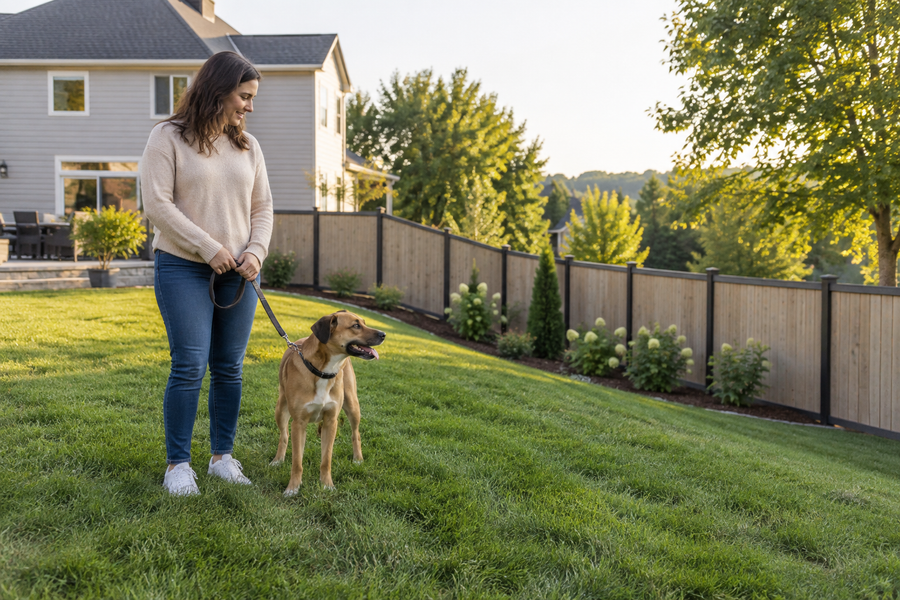
Choosing between a GPS dog fence and a traditional fence is not simply a choice between new technology and an old-fashioned barrier. The two systems manage different risks.
A traditional physical fence creates a visible barrier. It can physically slow or stop a dog from leaving the yard and can also help keep roaming dogs, wildlife, and strangers out. A GPS dog fence creates a digital boundary around a suitable outdoor area. It can provide boundary cues, escape alerts, and location tracking, but it cannot physically prevent a dog from crossing the line.
For a small yard beside a busy road, a secure physical fence is usually the stronger primary safeguard. For a farm, ranch, or large open property where building and maintaining miles of fencing may be impractical, a properly tested GPS fence can offer greater flexibility. Some households use both: a physical fence for containment and a GPS collar as an additional tracking and alert layer.
The right choice depends on your property, nearby hazards, your dog’s behavior, local rules, and how consistently you can train, supervise, test, and maintain the system.
30-Second Answer: Which Dog Fence Should You Choose?
| Your situation | Better starting point | Why |
|---|---|---|
| Small or narrow yard near traffic, water, or another immediate hazard | Traditional physical fence | Provides a visible physical barrier and leaves less room for normal GPS variation. |
| You need to keep wildlife, roaming dogs, or people out | Traditional physical fence | A GPS boundary only acts on the collar worn by your dog. |
| Large, open property with a clear view of the sky | GPS dog fence | Flexible boundaries can cover irregular spaces without trenching or permanent construction. |
| Rental, second home, campsite, or changing outdoor location | GPS dog fence, where the site is suitable | Digital boundaries can be moved or recreated, but the area still needs adequate space and a safe buffer. |
| Dog with intense prey drive, panic behavior, repeated bolting, or poor response to cues | Physical fence plus professional guidance | A motivated or frightened dog may run through a nonphysical boundary. |
| Existing fenced yard with concerns about open gates, digging, or escapes | Physical fence plus GPS tracking | The fence provides containment while tracking and alerts add a backup layer. |
Bottom line: A GPS dog fence is usually strongest as a flexible boundary-management and tracking system for suitable open properties. A traditional fence is usually stronger when you need dependable physical separation from an immediate hazard or from animals and people outside the yard.
What Counts as a Traditional Dog Fence?
In this guide, traditional fence means a physical structure such as:
- Wood or vinyl privacy fencing
- Chain-link or welded-wire fencing
- Metal, composite, masonry, or farm fencing
- A secure physical dog run
An underground wired electronic fence is different. It creates a nonphysical boundary through a buried wire and receiver collar, so it shares some limitations with wireless and GPS systems. If that is the option you are comparing, read our guide to wireless vs. in-ground dog fences.
GPS Dog Fence vs Traditional Fence: Key Differences
| Buying factor | GPS dog fence | Traditional physical fence |
|---|---|---|
| Main purpose | Creates a digital boundary and may provide tracking and escape alerts | Creates a fixed physical barrier |
| Physically stops a dog | No | Usually, when properly designed, maintained, and secured |
| Keeps outside animals or people out | No | Can help, depending on height, material, gates, and condition |
| Boundary shape | Flexible; supported shapes and minimum sizes vary by system | Determined by installed fence line and property access |
| Installation | App setup, perimeter testing, collar fitting, and dog training | Materials, posts, gates, labor, permits, and possible ground preparation |
| Portability | High | Very low |
| Location tracking | Available on connected GPS systems | Not included |
| Ongoing requirements | Charging, software/app access, training refreshers, testing, and often a service plan | Gate checks, vegetation control, and repairs for gaps, leaning posts, corrosion, or storm damage |
| Main failure risks | Low battery, poor satellite view, unsafe boundary placement, insufficient training, or a dog running through the cue | Open gate, digging, jumping, damaged panels, loose wire, or inadequate height |
| Strongest property fit | Larger open properties with room for an internal safety buffer | Small to medium fixed yards, narrow spaces, and boundaries near hazards |
| Works away from home | Often, after creating and testing a suitable new boundary | No |
Neither option is escape-proof. The difference is that a physical fence attempts to block movement, while a GPS fence relies on positioning, collar-based cues, training, and owner response.
Which Is Safer: A GPS Fence or a Physical Fence?
There is no honest category-wide answer that makes one system safest for every dog and property. Safety depends on what you need the fence to protect against.
When a Traditional Fence Is the Safer Primary Barrier
A secure physical fence is generally the better starting point when:
- The usable yard sits beside a road, driveway, cliff, pool, pond, or other immediate hazard.
- The property is too small to leave a generous buffer inside the real boundary.
- You need to keep coyotes, roaming dogs, livestock, children, or strangers outside the dog area.
- Your dog is likely to chase wildlife, panic at a cue, or bolt through a boundary.
- Dense buildings, heavy tree cover, or terrain repeatedly interfere with satellite reception.
- You cannot reliably keep the collar charged, fitted, and active.
A physical fence can still fail. Dogs may dig underneath, climb or jump over it, squeeze through gaps, or escape through an open gate. Regular inspection and appropriate height, material, and gate security still matter.
When a GPS Dog Fence May Be a Practical Fit
A GPS fence may be appropriate when:
- The property is large, open, and difficult or costly to fence physically.
- There is enough space to place the digital boundary well inside roads, neighboring land, water, and other hazards.
- The collar has a reliable view of the sky across the usable area.
- Your dog responds calmly and consistently to training cues.
- You can test the entire perimeter, monitor battery status, and supervise the learning process.
- You value portable boundaries, escape alerts, and live location tracking.
GPS.gov explains that satellite positioning can be degraded by signal blockage from buildings, bridges, and trees, as well as signals reflected from walls. That is why a GPS boundary should never be drawn directly along a dangerous edge. Learn more about how a GPS dog fence works before relying on one.
GPS Dog Fence Cost vs Traditional Fence Cost
The less expensive option depends on the property. Compare the total cost of ownership, not just the collar price with the cost of fence materials.
Traditional Fence Costs May Include
- Materials, gates, hardware, labor, and equipment
- Surveying, permits, and HOA approval where required
- Vegetation clearing, grading, or difficult terrain
- Added height or dig guards for escape-prone dogs
- Repairs, repainting, corrosion treatment, and replacement sections
The total usually rises with linear footage, difficult terrain, premium materials, multiple gates, and local labor costs. A physical fence may still provide long-term value because it does not normally require a monthly connectivity plan.
GPS Dog Fence Costs May Include
- Collar hardware and accessories
- A service plan for connected features, depending on the system
- Setup, perimeter testing, and training time
- Possible repair or replacement over several years
GPS systems often avoid major construction, making them financially attractive for large or irregular properties. However, a lower initial cost does not make a GPS fence the safer choice for a small yard next to traffic.
Use a 1-, 3-, and 5-Year Comparison
| Time frame | Traditional physical fence | GPS dog fence |
|---|---|---|
| Initial setup | Materials + labor + gates + permits + site preparation | Device + accessories + initial service plan, if required |
| Annual cost | Inspection, vegetation control, and repairs | Service plan + possible accessories or repairs |
| Major future cost | Storm damage, gate replacement, leaning posts, rust, or full sections | Battery degradation, device replacement, or plan-price changes |
Ask for local fencing quotes and verify current device and plan pricing. For connected collars, check coverage, renewal, cancellation, and feature-access terms.
Installation and Maintenance: Which Requires More Work?
Installing a Traditional Fence
A physical fence may require property-line confirmation, utility-location services, permits, HOA approval, ground preparation, and dog-appropriate height and spacing.
Once installed, walk the perimeter regularly. Look for loose boards, sharp edges, gaps, soil erosion, digging, failing latches, and objects a dog could use as a climbing platform.
Setting Up a GPS Dog Fence
A GPS fence avoids posts and trenching, but it is not simply “draw a line and let the dog loose.” Responsible setup includes:
- Confirming that your dog meets the collar’s size and fit requirements.
- Mapping the boundary well inside the true property edge.
- Leaving a wider buffer near traffic, water, neighboring property, dense trees, and structures.
- Walking and testing the full perimeter under normal local conditions.
- Introducing the boundary with a leash or long line and visible training markers.
- Using calm, reward-based training until the dog responds consistently.
- Rechecking the boundary after major seasonal, environmental, or property changes.
The American Veterinary Society of Animal Behavior recommends reward-based training and advises against aversive methods, including electronic shock collars. If your dog shows fear, panic, aggression, or repeated attempts to run through the boundary, stop and consult a qualified reward-based trainer or veterinary behavior professional.
What Happens When Either Fence Fails?
Thinking about failure modes leads to a safer decision than asking which system sounds more advanced.
GPS Fence Failure Scenarios
- The collar battery is depleted or the collar is removed.
- Satellite reception becomes unreliable around buildings, dense canopy, or covered areas.
- Cellular coverage delays live tracking or phone alerts on a connected system.
- The boundary is placed too close to a hazard.
- The dog does not understand the cue or runs through it while frightened or highly motivated.
- The owner assumes the system works without testing the actual property.
Traditional Fence Failure Scenarios
- A gate is left open or a latch does not close completely.
- A dog digs underneath, squeezes through, climbs, or jumps over.
- Storms, falling branches, corrosion, or ground movement damage the fence.
- Vegetation or stored objects create a climbing route.
- A fence is too short, widely spaced, or poorly matched to the individual dog.
Identification tags, a registered microchip, recall training, and supervision remain important whichever fence you choose.
Which Fence Fits Different Properties?
| Property | Better fit and key caution |
|---|---|
| Small urban or suburban yard | A physical fence is usually stronger near streets, sidewalks, neighbors, pools, or other hazards. |
| Farm, ranch, or large open property | A GPS fence can reduce construction needs and support flexible boundaries, but hazardous areas still need a wide buffer or physical protection. |
| Wooded or obstructed property | Test tree lines, valleys, metal buildings, and narrow passages. Use physical containment wherever reception is unreliable near a hazard. |
| Rental, vacation home, or campsite | A portable GPS boundary may work where permitted and where enough safe space exists. Create and test each new boundary. |
| HOA-restricted property | A GPS system may avoid visible construction, but owners must still check HOA rules, lease terms, local laws, and site suitability. |
Which Fence Fits Different Dogs?
Behavior matters more than broad breed labels.
| Dog factor | What to consider |
|---|---|
| Strong prey drive or repeated bolting | A physical barrier is usually the safer primary layer. GPS tracking may provide backup location awareness. |
| Fearful, anxious, or noise-sensitive behavior | Avoid forcing the dog through boundary training. Seek professional guidance and prioritize secure physical management. |
| Calm response to cues and reliable basic training | The dog may be a better candidate for a carefully introduced GPS boundary on a suitable property. |
| Small body or narrow neck | Check device weight, neck-size requirements, fence gaps, and gate spacing. Do not assume every GPS collar fits a toy breed. |
| Jumping, climbing, or digging | Match physical fence height and design to the behavior; consider GPS tracking as an additional escape-response tool. |
| Multiple dogs | Evaluate and train each dog individually. One dog’s response does not predict another’s. |
Never rate containment only by size or breed. A calm large dog and a determined small terrier can require completely different plans.
Can a GPS Dog Fence Replace a Physical Fence?
Sometimes it can replace construction as the main boundary-management tool on a suitable large, open property—but it cannot reproduce the physical protection of a real fence.
A GPS fence does not:
- Stop a vehicle, animal, or person from entering the property
- Guarantee that a dog cannot cross the boundary
- Continue working with a dead battery or poorly fitted collar
- Eliminate the need for training and supervision
- Make a narrow yard beside a road safe
If physical fencing is practical and the environment contains immediate hazards, it is often the more dependable primary barrier. If physical fencing is impractical across a large open area, a GPS fence may provide useful freedom and earlier escape awareness when its limitations are actively managed.
Why Some Owners Use Both
Layered safety can address the weaknesses of each system.
- The physical fence provides the primary barrier.
- A GPS collar can alert the owner and show the dog’s location if a gate is left open or the dog escapes.
- Identification tags and a microchip help someone return the dog if the device is lost or unavailable.
- Recall training and supervision reduce dependence on any single tool.
Using both does not make escape impossible, but it reduces the chance that one open gate, damaged panel, depleted battery, or delayed alert becomes the only line of defense.
How SATELLAI Fits This Comparison
SATELLAI Collar is designed primarily for farms, ranches, large yards, and other open properties where planned virtual-fence areas are 0.5 acre or larger. Current listed features include:
- Unlimited customizable virtual fences and no-go zones
- Real-time GPS tracking and escape alerts
- Configurable boundary feedback
- A 14–30-inch neck-size range
- Up to three days of maximum active-use battery life
- IP68 water and dust resistance
Connected features require an active Telecom Plan, and performance still depends on fit, charging, satellite reception, cellular coverage for app communication, boundary placement, and training. The collar does not create a physical barrier or guarantee containment.
Before purchasing, review the current wireless GPS dog fence specifications and compatibility guidance, then test the system across the actual property.
Frequently Asked Questions
Is a GPS dog fence as safe as a traditional fence?
They provide different protection. A traditional fence creates a physical barrier and can help keep outside threats out. A GPS fence provides a digital boundary and may add tracking and alerts, but it cannot physically stop a dog.
Can a dog run through a GPS fence?
Yes. A frightened, distracted, or highly motivated dog may cross the boundary despite a warning cue. Safe placement, a large internal buffer, reward-based training, and supervision are essential.
Does a GPS dog fence need cellular service?
GPS/GNSS determines position, while cellular service usually sends updates and alerts to the owner’s phone. Some on-collar boundary functions may continue after syncing, but this varies by product. Check the model, plan requirements, and coverage.
Is a GPS dog fence cheaper than a physical fence?
It often avoids major construction on large properties, but it may include service fees and future device replacement. Compare total costs over one, three, and five years.
Do GPS dog fences work under trees?
They may, but dense canopy can weaken satellite signals. Test the entire boundary, leave a larger safety buffer, and use physical containment wherever positioning is repeatedly unreliable.
Do GPS dog fences require training?
Yes. Dogs do not naturally understand a line drawn in an app. Introduce the boundary gradually with visible markers, a leash or long line, and reward-based training. Stop if the dog shows fear, panic, or repeated confusion.
Can I use a GPS collar with an existing physical fence?
Yes. This is often one of the most practical uses of GPS tracking. The physical fence remains the primary barrier, while escape alerts and live location can help the owner respond if a gate is left open or the dog finds another way out.
Final Takeaway
A traditional physical fence is usually the stronger primary choice near traffic, water, and other immediate hazards, or when outside animals and people must be kept out. A GPS dog fence is usually better suited to large, open properties where flexible boundaries and tracking provide meaningful advantages.
The safest decision is not the most technologically advanced or the most permanent. It is the option that fits the individual dog, the actual property, the nearby hazards, and the owner’s ability to train, test, supervise, and maintain the system consistently.
Editorial and Accuracy Note: This guide was reviewed on August 25, 2026 against current SATELLAI product information, GPS.gov accuracy guidance, and the American Veterinary Society of Animal Behavior’s humane training position. Product features, prices, plan terms, cellular coverage, and local regulations can change. Verify current specifications and local requirements before purchase or use.