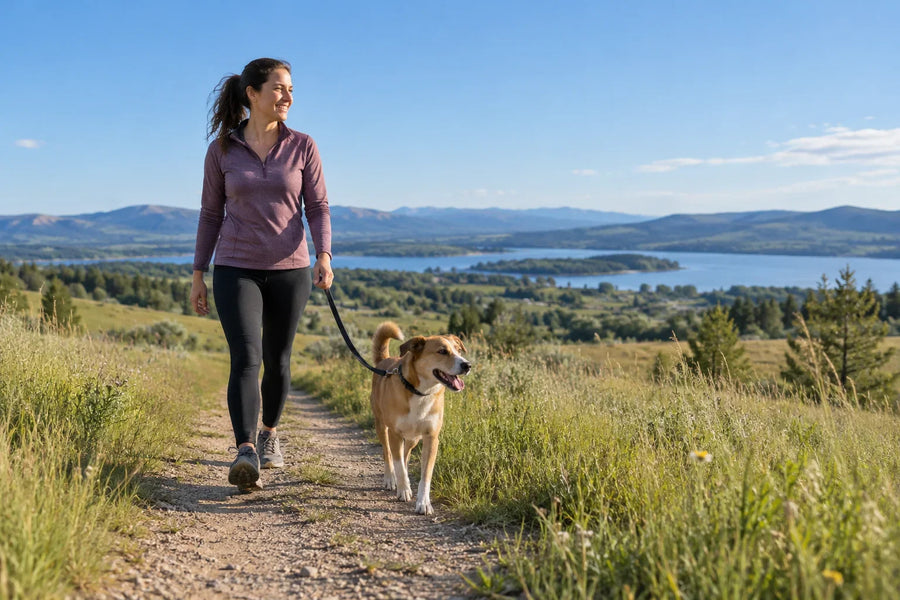
The best dog fence for a farm is the one that addresses the farm’s specific risks—not necessarily the system with the largest advertised range. A boundary beside a public road needs a different solution from an interior pasture, and a dog that works around livestock needs a different plan from a family dog that stays near the farmhouse.
For many farms, the safest answer is a combination: physical fencing around immediate hazards, supported by training, identification, and GPS tracking or virtual boundaries across lower-risk open areas.
30-Second Answer
- Physical fencing is usually the strongest choice beside roads, neighboring animals, machinery, and other high-consequence hazards.
- In-ground electronic fencing can follow a stable custom perimeter but becomes more labor-intensive across large acreage.
- Transmitter-based wireless fencing is simple to install but is often better suited to smaller circular areas.
- GPS virtual fencing works well for large or irregular usable areas because it requires no buried wire, but it cannot physically contain a dog.
- The best farm setup often uses more than one type of boundary.
First, Identify the Risks Around Your Farm
“Farm” can describe five open acres around a home or hundreds of acres with livestock, equipment, woods, and public access. Before comparing products, walk the area and identify what would happen if the dog crossed each edge.
Pay particular attention to:
- public roads, long driveways, and delivery entrances;
- cattle, horses, poultry, and unfamiliar livestock;
- ponds, irrigation canals, wells, and steep banks;
- tractors, workshops, chemical storage, and grain areas;
- neighboring dogs and property lines;
- hunting areas, woods, and wildlife corridors;
- metal-roofed barns and places with weak cellular coverage.
The higher the consequence of crossing a boundary, the stronger the case for a physical barrier. A virtual line may be useful in open pasture, but it should not be the only layer separating a dog from fast traffic or an unsafe livestock interaction.

Comparing the Main Farm Dog Fence Options
| Fence type | Where it works best | Advantages | Limitations |
|---|---|---|---|
| Physical fence | Roads, livestock pens, kennels, high-risk perimeters | Visible, physical separation; can also deter outside animals | High cost over long distances; gates and digging/climbing risks still need management |
| In-ground electronic fence | Stable custom areas around the home or farmyard | Follows irregular shapes; consistent buried-wire boundary | Installation and repairs become harder with acreage; no physical barrier |
| Transmitter-based wireless fence | Smaller open farmyards | Fast, portable setup without trenching | Usually circular; coverage and building placement may be restrictive |
| GPS virtual fence | Large pastures and irregular lower-risk areas | App-based custom boundaries; no buried wire; portable | Depends on positioning, battery, training, and system condition; no physical barrier |
An official PetSafe product overview illustrates how widely these systems vary: transmitter-based wireless products may cover fractions of an acre, while in-ground systems can expand farther and GPS products serve larger custom areas. Review the specifications of the exact system rather than treating “wireless fence” as one category: GPS, wireless, and in-ground dog fence examples.
When a Physical Fence Is the Best Choice
Physical fencing remains the preferred foundation when a mistake could put the dog, livestock, drivers, or visitors in immediate danger. Good candidates include:
- the edge of a public road;
- a kennel or unsupervised turnout area;
- poultry runs and birthing areas;
- equipment and chemical storage zones;
- boundaries shared with unfamiliar dogs;
- small areas where a GPS safety buffer would leave too little usable room.
Fence material and height should reflect the dog’s behavior. A climber, digger, livestock chaser, or dog that pushes through gates needs a design that addresses that behavior. No fence should be assumed escape-proof without routine inspection.
When an In-Ground Fence Makes Sense
An in-ground electronic fence can be useful around a stable farmyard where owners want a custom shape without a visible barrier. Once installed, the buried wire creates a consistent perimeter.
The tradeoff is installation and maintenance. Long wire runs take time to trench, and breaks can be difficult to locate. Changes to fields, driveways, landscaping, or buildings may also require the boundary to be redesigned.
Like GPS and transmitter-based systems, an in-ground electronic fence does not block wildlife, roaming dogs, or people from entering the property.
When a Transmitter-Based Wireless Fence Fits
A base-station wireless fence can be practical around a farmhouse, campsite, or other compact open area. Setup is usually faster than installing buried wire.
However, many transmitter systems create a circular boundary. That may be awkward on a narrow or irregular farmyard, especially when a circle reaches across a driveway, road, pond, or livestock pen. Buildings and transmitter placement also affect the usable area.
For a deeper explanation of radio and GPS systems, see how a wireless dog fence works.
When a GPS Dog Fence Fits a Farm
GPS virtual fences are most compelling when the desired area is large, open, and irregularly shaped. Owners can map a boundary in an app without trenching wire through fields, driveways, or changing terrain.

Look for:
- custom-shaped fences rather than circular zones only;
- internal no-go zones for ponds, barns, gardens, or livestock areas;
- a suitable minimum boundary size;
- dependable positioning across the actual terrain;
- configurable on-collar cues;
- clear behavior when cellular coverage is weak;
- live location tracking and escape alerts;
- practical battery life and water resistance;
- support for every dog that will use the system.
If the primary need is open acreage, our guide to choosing the best GPS dog fence for large properties provides a more detailed buying checklist.
Farm Conditions That Can Affect GPS Performance
Large open pastures can provide favorable satellite visibility, but every farm has its own difficult areas. Dense woods, steep terrain, tall structures, and metal roofs may affect how quickly a collar establishes or maintains its position. Cellular dead zones can also limit live tracking and phone notifications even when a stored boundary continues operating on the collar.
Before regular use:
- walk every part of the proposed boundary;
- test around barns, wooded edges, slopes, and water;
- place the digital line well inside dangerous edges;
- repeat the test in normal working conditions;
- keep a physical barrier wherever a delayed or missed cue would create unacceptable risk.
Is SATELLAI Collar Suitable for Farms?
The SATELLAI Collar is designed for large yards, farms, ranches, and other open spaces. It supports customizable virtual fences starting at 0.5 acre, internal no-go zones, real-time GPS tracking, configurable feedback, and location alerts. Current specifications list IP68 water resistance and up to three days of maximum battery life.
Fence settings are stored on the collar, which is useful when the dog moves beyond a strong phone connection. However, real-time tracking, phone alerts, and app-based services require an active Telecom Plan and adequate network coverage.
SATELLAI Collar can be a useful interior-farm boundary and recovery layer. It should not be described as a substitute for secure physical fencing beside roads, dangerous livestock, machinery, or other high-risk areas.

Build a Layered Farm Dog Safety System
The most reliable farm plan does not ask one tool to solve every risk.
Layer 1: Physical Protection
Secure the farmhouse turnout area, roadside boundaries, animal enclosures, gates, and equipment zones. Inspect regularly for digging, storm damage, open gates, and loose wire.
Layer 2: Boundary Training and Recall
Teach a clear return behavior on leash or a long line. Add distractions gradually and reward the dog for disengaging from livestock, wildlife, vehicles, and property edges. A working recall should be practiced in the actual places where it will be needed.
Layer 3: Identification and Tracking
Use a collar with current identification and keep the dog’s microchip registration up to date. The American Veterinary Medical Association recommends pairing a microchip with current collar identification because the tools serve different purposes: microchips and pet identification.
A GPS collar adds active location information, but it does not replace permanent identification.
Layer 4: A Recovery Plan
Keep recent photos, the dog’s microchip number, veterinary contact details, and a list of nearby shelters or animal control agencies in one accessible place. Decide who checks the road, fields, barns, and neighboring properties if the dog goes missing.
Common Farm Fence Mistakes
- Choosing by total acreage without mapping the actual safe area.
- Running a virtual boundary directly beside a road or pond.
- Assuming open pasture performance will be identical beside a metal barn or dense woods.
- Allowing off-leash use before the dog understands the boundary cues.
- Forgetting to charge the collar or inspect its fit.
- Using one collar for multiple dogs when the system requires one device per dog.
- Treating a virtual fence as a physical barrier against wildlife or livestock.
Final Verdict
There is no single best dog fence for every farm. Physical fencing offers the strongest separation around high-risk areas. In-ground systems suit stable custom perimeters, transmitter-based wireless systems fit smaller open zones, and GPS fences provide flexible coverage for large or irregular lower-risk spaces.
For many farms, the best answer is a layered setup: secure physical boundaries where consequences are high, plus training, identification, and GPS location tools where dogs have more room to work or explore.

Frequently Asked Questions
What is the best fence for a farm dog?
The safest choice depends on the hazards. Use physical fencing near roads, livestock, machinery, and unsupervised areas. GPS virtual fencing can add flexible boundary support and tracking across large, lower-risk open spaces.
Can a wireless dog fence cover a farm?
Some GPS systems can cover large farms, while transmitter-based wireless fences generally cover smaller circular areas. “Wireless” does not indicate one standard range, so check the technology, minimum and maximum area, and boundary shape.
Will a GPS dog fence work near a barn?
It may, but metal roofing and large structures can make satellite positioning more difficult. Test around every side of the barn and move the virtual boundary away from areas where inconsistent positioning could create danger.
Can one GPS fence support multiple farm dogs?
Many systems allow several dogs to be managed in one app, but each dog normally needs a compatible collar and may require a separate service plan. Confirm the product’s multi-dog rules before purchase.
Is a GPS fence safe around livestock?
A GPS fence may help define where a trained dog should work, but it cannot physically separate the dog from livestock. Use secure physical barriers where an interaction could injure either animal.