Helping a dog through their senior years is usually less about stopping activities and more about adjusting them.
Your dog may still want walks, attention, play, sniffing time, and familiar routines. What changes is how much activity feels comfortable, how quickly they recover, and how much support they need around the house.
Because dogs of different sizes reach senior life at different ages, start by looking at your dog's individual life stage. If you are unsure, use the SATELLAI Dog Age Calculator for a general estimate based on age and adult body size.
Quick Answer: What Does a Senior Dog Need Most?
Senior dogs generally benefit from consistent low-impact activity, a comfortable and accessible home, an appropriate diet and body condition, regular mental enrichment, closer observation of behavior and mobility, and more proactive veterinary care.
The goal is not simply to make life quieter. It is to help your dog remain comfortable, mobile, mentally engaged, and connected to everyday routines for as long as possible.
AAHA's senior-care guidance emphasizes individualized care because older dogs can vary widely in mobility, cognition, hearing, vision, chronic pain, and medical needs. Read the AAHA Senior Care Guidelines.
1. Adjust Exercise Instead of Eliminating It
Older dogs still need movement. Regular activity supports muscle mass, mobility, weight management, mental stimulation, and normal daily routines.
The difference is that exercise may need to become shorter, gentler, or more frequent.
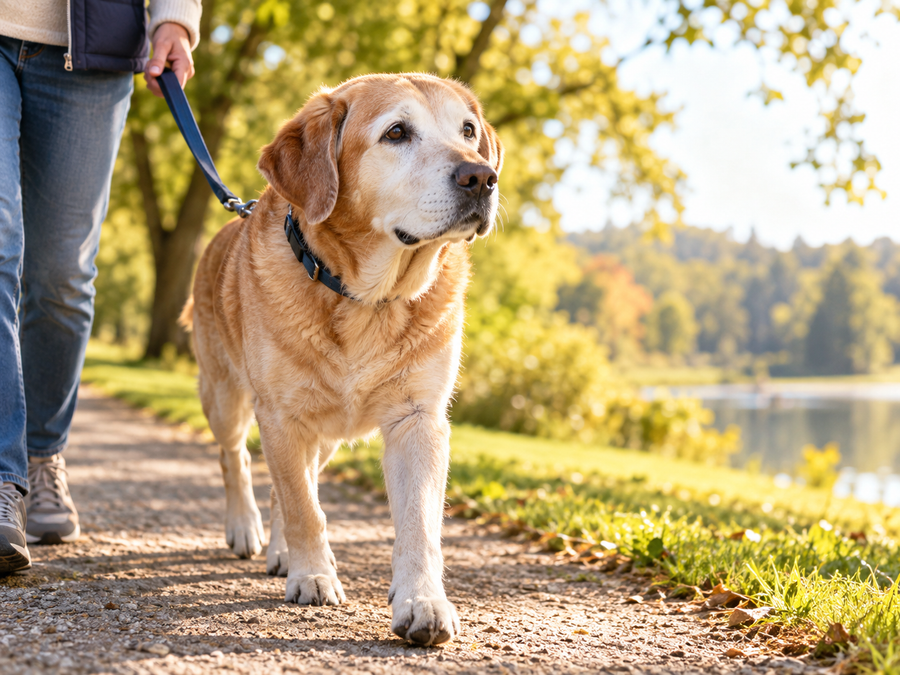
For example, a dog that once handled one long walk comfortably may do better with two or three shorter walks. Flat ground may be easier than steep trails. Gentle sniff walks may provide plenty of enrichment without asking for sustained high-intensity exercise.
AAHA recommends adapting exercise to a senior pet's physical condition and mobility, with low-impact activities such as gentle walking or light swimming when appropriate. AAHA's senior-pet guide also emphasizes short, consistent activity rather than overexertion.
2. Pay Attention to Recovery After Activity
How your dog feels after exercise can tell you as much as what they can do during it.
A senior dog may enthusiastically finish a walk and then become stiff later that evening or struggle to get up the next morning. That can be a sign that the activity was more demanding than it appeared at the time.
Watch for longer recovery naps, stiffness, slower movement, hesitation on stairs, or reduced enthusiasm for the next outing. If those patterns become consistent, adjust duration or intensity and discuss persistent changes with your veterinarian.
3. Make the Home Easier to Navigate
Small changes at home can make a surprisingly large difference for an older dog.
Slippery floors can become difficult when muscle strength, joint comfort, or balance changes. Stairs and high furniture can also become harder to manage.
Depending on your dog's needs, useful changes may include:
- nonslip rugs or runners on smooth flooring
- ramps or pet steps for beds, couches, or vehicles
- comfortable bedding with good support
- food and water placed in easy-to-reach locations
- night lighting in frequently used areas
- keeping familiar pathways free of clutter
AAHA specifically recommends environmental modifications such as ramps, steps, and nonslip surfaces for senior pets with reduced mobility.

4. Give Your Senior Dog a Comfortable Place to Rest
Older dogs often spend more time sleeping and recovering, so their resting area becomes increasingly important.
Choose a bed that is easy to enter and exit. Place it somewhere familiar and comfortable, away from constant household traffic but close enough that your dog still feels included.
If your dog changes sleeping positions frequently, avoids a once-favorite bed, or seems unable to settle comfortably, pay attention. Restlessness can sometimes be related to discomfort rather than simple preference.
5. Keep Weight and Muscle in Mind
Aging can change calorie needs, muscle mass, and activity level.
Some senior dogs gain weight as they move less. Others lose muscle even when their scale weight appears relatively stable. Both situations are worth monitoring.
Rather than changing food solely because the package says "senior," discuss your dog's body condition, health history, activity level, and nutritional needs with your veterinarian.
AAHA notes that senior nutrition should be individualized, particularly when older pets have existing health conditions or changing energy needs.
6. Continue Mental Enrichment
Senior dogs still need opportunities to use their brains.
Physical activity may become gentler, but enrichment can remain a meaningful part of everyday life. Sniffing, simple food puzzles, easy training exercises, hide-and-seek games, and calm exploration can provide stimulation without requiring intense movement.
Keep the difficulty appropriate. The goal is engagement, not frustration.
If your dog seems less interested in familiar games, experiment with simpler versions rather than removing enrichment entirely.

7. Keep Routines Predictable
Predictable routines can become especially helpful when hearing, vision, mobility, or cognition starts changing.
Regular meal times, familiar walking routes, consistent sleeping areas, and predictable bathroom breaks can make daily life easier to navigate.
This does not mean every day needs to be identical. Senior dogs can still enjoy new scents, new routes, visitors, and enrichment. The key is introducing change at a pace your dog handles comfortably.
8. Watch for Changes in Hearing and Vision
Hearing and vision may gradually decline with age.
A dog with hearing loss may sleep through familiar sounds, stop responding to verbal cues from another room, or startle when someone approaches from behind.
A dog with reduced vision may hesitate in dim lighting, move more carefully on stairs, or become less confident in unfamiliar environments.
Keeping furniture arrangements consistent and approaching where your dog can see or sense you can help. Visual hand cues may also become useful if hearing declines.
9. Monitor Behavior, Not Just Physical Health
Behavioral changes can sometimes be one of the earliest signs that something is different.
Watch for new anxiety, confusion, nighttime restlessness, house-training changes, increased vocalization, reduced social interaction, or unusual irritability.
Do not automatically assume these changes are simply part of getting old. Pain, sensory loss, underlying disease, and cognitive changes can all influence behavior.
If you want a broader overview of what to watch for, read How Dogs Change as They Get Older.
10. Make Veterinary Care More Proactive
Senior dogs can appear healthy while early disease is developing beneath the surface. That makes regular veterinary monitoring increasingly useful.
AAHA notes that a senior evaluation may include history-taking about eating, drinking, exercise, movement, play, vision, hearing, behavior, and elimination, along with a thorough physical examination. Senior medical workups may also include bloodwork and urinalysis once or twice per year depending on the dog and veterinarian's recommendations. See AAHA's guidance for evaluating healthy senior pets.
Your veterinarian may recommend a different schedule based on breed, existing conditions, medications, previous test results, and individual risk factors.
What Changes Should Not Be Dismissed as Old Age?
Aging is gradual. Sudden or significant changes deserve attention.
Contact your veterinarian if you notice changes such as:
- sudden difficulty standing or walking
- persistent limping or signs of pain
- significant weight loss or gain
- major appetite changes
- increased thirst or urination
- breathing difficulty or persistent coughing
- repeated confusion or disorientation
- sudden aggression, fear, or personality changes
- loss of interest in normal activities
AAHA emphasizes that aging should not be treated as inevitable physical or behavioral decline that requires little intervention. Older dogs can benefit from proactive management and individualized care.
How Do You Know When Your Dog Is Senior?
There is no single birthday that applies to every dog.
AAHA defines senior dogs as being in approximately the final 25% of their expected lifespan. Large and giant breeds therefore tend to reach senior status earlier than small dogs.
For a more detailed explanation, read When Does a Dog Become a Senior?.
You can also use the Dog Age Calculator to get a general life-stage estimate based on chronological age and adult body size.
Final Takeaway
Caring for a senior dog is mostly about paying closer attention and making thoughtful adjustments.
Keep them moving, but respect slower recovery. Make the home easier to navigate. Protect healthy body condition and muscle. Continue enrichment. Watch behavior as carefully as physical health. And use veterinary care proactively rather than waiting for obvious problems.
Your dog may be getting older, but that does not mean the enjoyable parts of life have to disappear. The routine may change; the need for movement, comfort, curiosity, companionship, and engagement does not.
Frequently Asked Questions
How often should I walk a senior dog?
There is no universal schedule. Many older dogs do well with shorter, more frequent walks rather than one long outing. Exercise should be adjusted to mobility, health, stamina, and recovery.
Should senior dogs exercise every day?
Many senior dogs benefit from regular low-impact activity when their health allows it. Your veterinarian can help adjust exercise if your dog has arthritis, heart disease, neurological conditions, or other limitations.
Do senior dogs need more sleep?
Many older dogs rest more, but sudden sleep changes, nighttime pacing, or difficulty settling can also signal discomfort or other health changes.
How can I make my home safer for an old dog?
Nonslip rugs, ramps or steps, supportive bedding, better lighting, and easy access to food, water, and outdoor areas can make daily movement easier.
At what age should I start senior dog care?
There is no single age for every dog. Larger breeds often reach their senior years earlier. The SATELLAI Dog Age Calculator can provide a general estimate based on age and body size.