Dogs see a more limited range of colors and generally less fine detail than people with typical vision. Their eyes are adapted to use dim light, and their eye placement often gives them a wider view to the sides. How well they see depends on the task, the light, and the individual dog.
Your dog might lose a ball that looks obvious to you, then notice something moving in the yard before you do. Those moments involve different parts of sight. Color, detail, motion, and light all affect what an animal can see.
Here's how dog eyesight compares with human eyesight—and what those differences mean at home.
Dog Vision Compared to Humans
| Feature | Dogs | People with typical vision | What you may notice |
|---|---|---|---|
| Color | A more limited range, with difficulty separating red and green | A wider range of distinct colors | Your dog may lose a red ball on grass |
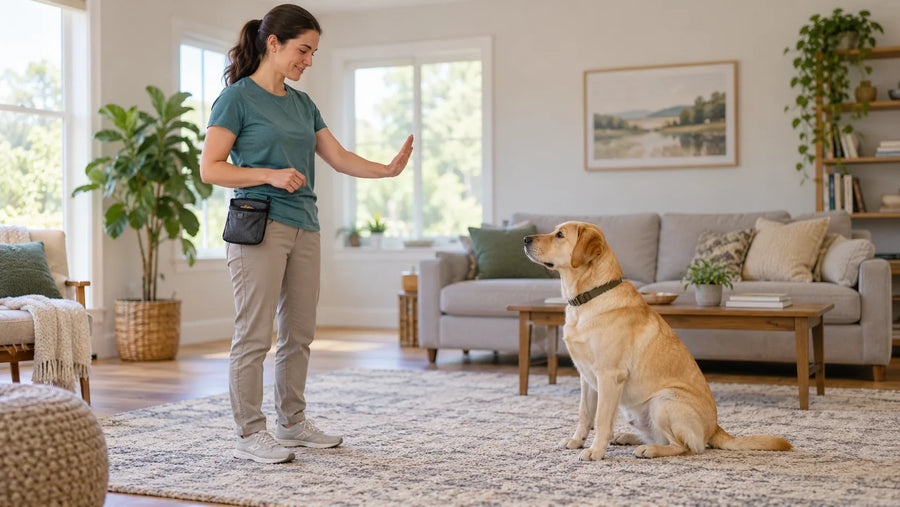
| Fine detail | Generally less sharp; varies among dogs | Generally sharper | A small hand gesture may be hard for your dog to identify from far away |
| Dim-light sensitivity | Eyes are adapted to use limited light | Usually less sensitive in low light | Your dog may notice activity at dusk before you do |
| Field of view | Often wider to the sides; depends on head shape | More forward-facing | Your dog may react to something beside you that you haven't noticed |
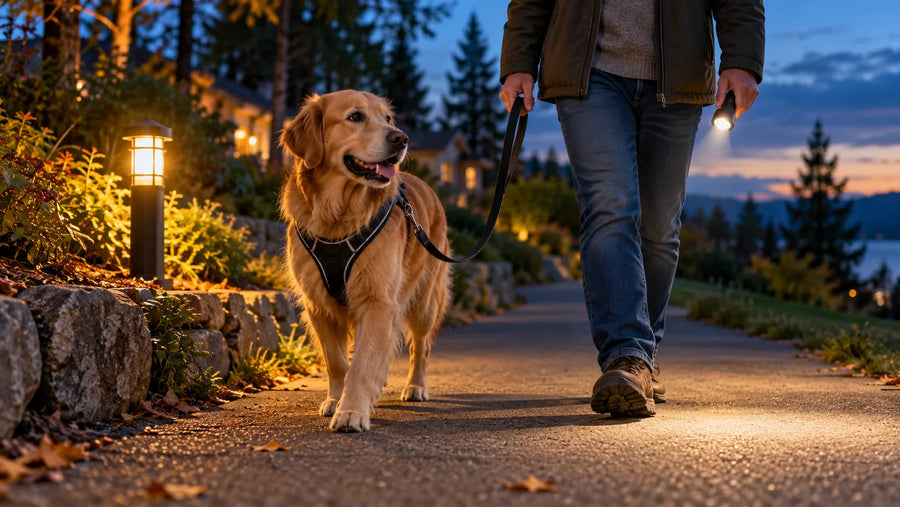
| Total darkness | Needs light to see | Needs light to see | Both of you still need illumination on a dark route |
These are broad comparisons. The veterinary review “Vision in Dogs” by Miller and Murphy describes how these parts of canine vision work together. Eye health, age, and anatomy also affect an individual dog's sight.
Dogs See Colors Differently
Dogs don't see only in black and white. They can distinguish blue and yellow, but some colors most people separate easily look more alike to them.
The reason is in the retina. Dogs have two classes of color-sensitive cone cells, while humans with typical color vision have three. The American College of Veterinary Ophthalmologists explains this difference.
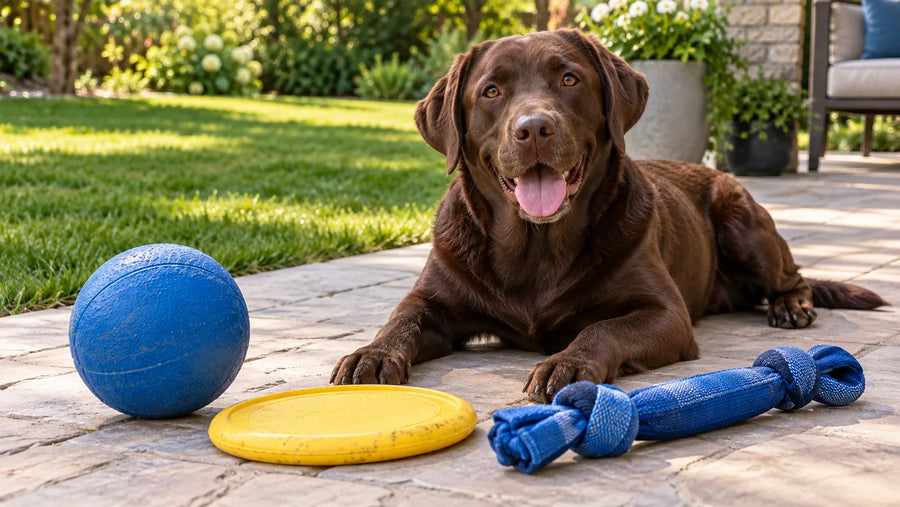
For everyday play, think about the object and its background together. A blue toy may stand out on grass but blend into a blue blanket. Our dog color vision guide includes a color-by-color chart.
How Sharp Is a Dog's Vision?
Visual acuity means how much fine detail an eye can resolve. Dogs generally resolve less detail than humans, but a single eyesight score doesn't describe every dog.
In a 2017 study by Lind and colleagues, researchers trained dogs and people to distinguish patterns in the same setup. People could distinguish finer patterns under both the bright and dim conditions tested. The dogs' results also varied substantially.
That's more useful than assuming every dog sees the same way. A large arm movement nearby and a subtle finger movement across the yard are very different signals.
Does every dog have 20/75 vision?
No. The familiar 20/75 figure is an estimate used to describe canine vision, not a score every dog receives.
In human eye-chart terms, 20/75 means resolving at 20 feet a detail that a person with standard 20/20 vision resolves at 75 feet. It doesn't mean everything beyond 20 feet is invisible.
The ACVO's explanation of visual acuity discusses this comparison. Dogs don't read eye charts, so researchers and veterinarians use other methods to assess sight. Lighting, test methods, and individual differences all matter.
Dogs Can Use Low Light Well, but Detail Still Matters

Dogs have eye structures that help them use limited light, including light-sensitive rod cells and, in most dogs, a reflective layer behind the retina.
That doesn't mean a dim scene looks as sharp as daylight. Noticing that something moved and identifying exactly what it is are different abilities.
The 2017 study above measured fine-detail discrimination, not the faintest light an eye could detect. That's why its results don't contradict the broader finding that dogs have adaptations for low light.
For nighttime routines and walks, see how dogs see in the dark.
A Dog's Field of View Depends on Their Head and Eyes
Dogs often have a wider side view than people because their eyes sit in different positions. That varies with head shape, so one exact viewing angle won't fit every breed.
The area both eyes see at once also differs. This overlap helps provide depth information, but it's only one part of judging distance. Dogs can still perceive depth.
Miller and Murphy's review discusses these anatomical differences. For an owner, a simple check can be helpful: crouch down and look at the scene from your dog's height. A chair, low wall, or patch of tall grass may block something that's easy for you to see while standing.

Why Can My Dog Follow a Ball but Lose It on the Ground?
A moving ball gives your dog something changing to track. Once it stops, they have to find it using its position, outline, color, and other clues.
If your dog misses the landing, or the ball settles into grass, the search gets harder. Help them find it, then try a shorter throw into a clearer area. See how to choose visible dog toy colors for more practical options.
What Does a Dog Vision Simulation Show?
A dog vision simulation can help explain a particular difference, such as reduced red-green color discrimination. It can't reproduce a dog's exact experience of the world.
A useful simulation tells you what it changes:
- Color: illustrates which hues may be difficult to tell apart.
- Blur: represents an assumed difference in detail, rather than measuring your dog's eyesight.
- Brightness: illustrates a lighting condition, without reproducing everything a living eye does as light changes.
Dog vision vs. human vision pictures are best treated as illustrations. A heavily blurred or yellow-tinted image isn't automatically more accurate than a simpler comparison with clearly explained assumptions.
What These Differences Mean for Training
If your dog misses a visual cue, make it easier to see before repeating it:
- Get their attention.
- Move closer.
- Keep your hand clear of a busy background.
- Use a distinct, familiar gesture.
- Check that the light isn't hiding the movement.
Our guide to hand signals for dogs shows how to teach those cues. A missed response can reflect visibility, distraction, or incomplete learning; it doesn't tell you on its own which one is responsible.
Frequently Asked Questions
Can dogs see better than humans?
It depends on what you're comparing. Dogs have adaptations for low light, while humans with typical vision distinguish more colors and finer detail.
How far can dogs see?
There isn't one useful maximum distance. A large moving object is easier to detect from far away than a small, still detail. Eyesight fractions such as 20/75 don't describe a cutoff distance.
How do dogs see humans?
They see your shape and movements from their own viewpoint. Recognizing you also involves familiar sounds, scent, and experience, so a response to you can't be explained by sight alone.
Is my dog's world blurry?
Dogs generally see less fine detail than humans, but one blur filter can't represent every dog or scene. Distance, light, the object, and eye health affect what your dog can make out.
What if my dog's vision seems to be changing?
Call your veterinarian if your dog starts bumping into things or struggling with familiar places. A painful-looking eye, squinting, or holding an eye closed also needs prompt care; VCA lists these among signs to have checked.