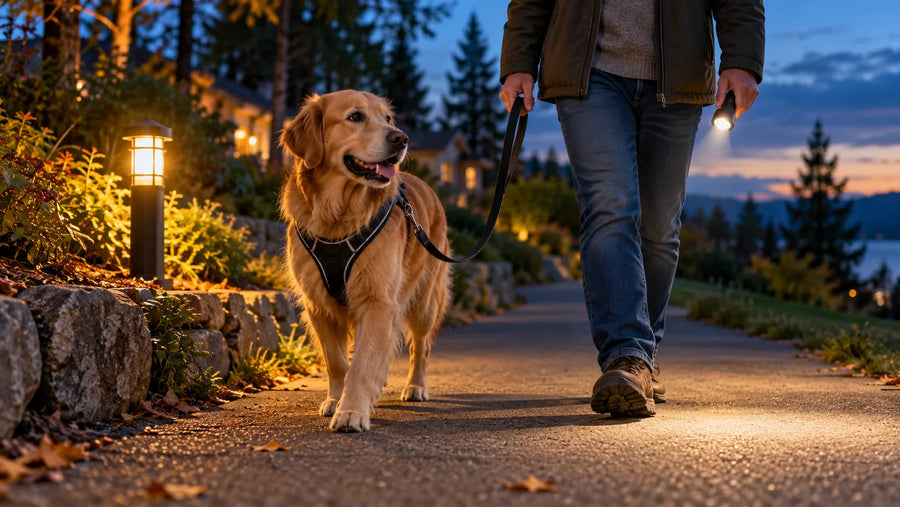
Dogs can see shades of blue and yellow, along with shades of gray. They have trouble telling red from green because they have two types of color-sensitive cone cells, compared with three in people with typical color vision. Your dog's world has color—just a more limited range than yours.
Ever thrown a red ball onto the lawn and watched your dog run right past it? The color may be part of the problem. That ball can look much less distinct against grass to your dog than it does to you.
Understanding dog color vision can help you choose an easier-to-find toy, make training cues clearer, and set up a better game of fetch.

Dog Color Vision Chart: What Colors Do Dogs See?
Dogs don't experience the same rainbow most people do. Some colors that look very different to us are harder for them to tell apart.
| Color you see | How it may look to a dog | What that means during play |
|---|---|---|
| Blue | Blue tones | Worth trying against grass or tan ground |
| Yellow | Yellow tones | May stand out against blue fabric |
| Red | Dark brownish or grayish tones | May be harder to spot on a lawn than you expect |
| Orange | Yellowish tones | May blend with dry grass or other yellowish surfaces |
| Green | Yellowish or muted tones | Can be difficult to tell apart from some other colors |
| Purple | Bluish tones | May be hard to distinguish from blue |
| Black, white, and gray | Differences in brightness | A light or dark outline can still help an object stand out |
These are broad approximations, not exact color matches. The shade and lighting matter. VCA Animal Hospitals explains these common color differences; the play suggestions apply that information to familiar settings rather than report results from a toy test.
Can dogs see red and green?
Dogs can see red and green objects. The difficulty is telling those colors apart the way most people do.
A red ball still has a shape, an outline, and a particular brightness. Your dog may follow it while it rolls, then lose track of it once it stops in the grass. Scent can help them find it again.
Can dogs see blue and yellow?
Yes. Dogs can distinguish blue from yellow. That's why these colors are useful starting points for toys you want your dog to find by sight.
The background still matters. A blue toy on a blue blanket may be harder to pick out than a yellow one.
What about orange, purple, and pink?
Orange may look yellowish, while purple may look more like blue. Pink includes a wide range of shades, so there isn't one exact answer for every pink object. A pale pink toy and a dark pink toy can differ in brightness as well as color.
Why Do Dogs See Colors Differently?
The retina contains light-sensitive cells called photoreceptors. Cone cells help distinguish color. Dogs have two classes of cones, a system called dichromatic vision. People with typical color vision have three.
The American College of Veterinary Ophthalmologists describes canine color vision as allowing blue-yellow distinctions while making red-green distinctions difficult. Two cone types don't limit dogs to two flat colors; they can still see shades and differences in brightness.

Behavioral research supports this. In Neitz, Geist, and Jacobs' 1989 color-vision study, tests with three dogs produced results consistent with dichromatic vision.
A 2013 study by Kasparson and colleagues also found that eight dogs generally used learned color cues when choosing between colored stimuli that differed in brightness. The takeaway is that dogs can use color to make choices. The experiment didn't identify a favorite color or compare dog toys.
Are Dogs Color Blind?
Dogs are color blind in the sense that they don't make all the color distinctions most people can. They don't see only in black and white.
Human red-green colorblindness is a helpful comparison, although it doesn't describe every aspect of a dog's vision. Dogs also differ from people in how much detail they can see and how their eyes handle low light.
This limited color range is normal for dogs. It's separate from losing vision because of an eye problem.
What Colors Can Dogs See Best?
Blue and yellow are good colors to try when you want your dog to find or distinguish an object. Choose one that stands out against the background, too.
For fetch on grass, start with blue. On a blue rug, try yellow. A toy's size, the amount of light, and whether it's partly hidden can matter as much as its color.
You don't need to replace a favorite red toy that your dog finds easily. And a color that's easier to see isn't necessarily a color your dog prefers. The toy's smell, texture, sound, and history of fun games can all matter.
Our guide to the best colors for dog toys walks through common indoor and outdoor backgrounds.
How to Use This During Play and Training
Make fetch easier to follow
Start with a short throw into an open patch of ground. Let your dog watch where the ball lands. If they keep losing it, move to shorter grass, try a contrasting color, or reduce the distance.
Keep hand signals clear
Get your dog's attention before giving a gesture. Stand close enough for them to see it, and keep your hand clear of a busy background. A broad, consistent movement is a better starting point than a small finger motion. See our guide to hand signals for dogs for step-by-step practice.
Add light when the sun goes down
A blue or yellow toy won't make up for a dark play area. Move somewhere well lit as daylight fades. Our guide to dogs' night vision explains why low light changes the task.
Can a Picture Show Exactly What Dogs See?
A dog vision simulation can illustrate color differences, but it can't recreate a dog's exact experience. A color filter also leaves out other parts of sight, including detail, viewing angle, and changes in lighting.
Treat side-by-side pictures as teaching aids. A useful comparison explains what was changed and labels the result as approximate. For the broader differences, read dog vision vs. human vision.
Frequently Asked Questions
What colors can dogs not see?
Dogs have difficulty telling red from green and distinguishing some other hues. That doesn't make objects in those colors invisible. Shape, brightness, motion, and scent still provide clues.
Do dogs see grass as green?
Grass doesn't look the same green to a dog as it does to most people. It may look more yellowish or muted. That can reduce the color contrast between a lawn and some toys.
Is blue a dog's favorite color?
There isn't a favorite color established for all dogs. Finding a blue toy easily doesn't prove your dog prefers blue; they may like the toy for other reasons.
Does missing a ball mean my dog has bad eyesight?
One missed ball doesn't tell you much. Check the grass, lighting, and where the toy landed. If your dog starts having trouble finding familiar objects or getting around at home, call your veterinarian. Squinting or holding an eye closed also needs prompt attention, as VCA's eye-care guidance explains.